The night sky over Ballymoney
The universe is getting on with things. Here’s what it’s up to tonight, and whether you can see any of it from where you are.
My telescope is in Ballymoney: the nights in my diary are this sky. The diary.
Tonight, Tuesday 24 November
Cloudy all night: most of the centres say so for every hour. (all 4 forecasting centres agree)
- Cloud measured at City of Derry Airport, about 45 km away, at 20:50: a few clouds at 3,000 ft.
- Cloud measured at Belfast International Airport, about 55 km away, at 20:50: no low cloud that matters to aviation, mist.
- Cloud measured at Malin Head, about 60 km away, at 20:30: a few clouds at 4,600 ft.
- Each sensor measures only the sky straight above it, and airports can’t rule out high cloud. Collected by cloudyoke.
- If you want to help improve your local predictions, you can register interest in hosting a cloudyoke sensor.
Coming up, and worth knowing
- Next: Uranus at opposition, Thursday 26 November.
- A star that exploded in the galaxy NGC 4189 is up from here tonight, at magnitude 12.5.
- PoorA quick lookcloud all night
- PoorThe Moon and planetscloud all night
- PoorBright clusterscloud all night
- PoorFaint galaxiescloud all night
- From the satellite: Meteosat’s cloud mask shows cloud over part of this 0.1° square, and over its centre, in its image of 20:45. It sees here at 63° from overhead, so high cloud can show up some kilometres from where it really is.
- Properly dark from 18:25 to 06:10.
- The Moon is 100% lit and waning, rising at 15:18 and setting at 10:06: up for 11.8 hours of the dark.
- Your sky: about Bortle 4 (21.1 mag/arcsec²), from a light-pollution atlas for this spot. A model, not tonight's measurement.
- Dew risk from 18:00: the air is within 2°C of its dew point in 4 of the forecasts.
- 18:00: not forecast clear (cloud), 0 of 4 centres clear; air steady, seeing 0.75-1 arcseconds; Moon up; twilight
- 19:00: not forecast clear (cloud), 0 of 4 centres clear; air steady, seeing 0.75-1 arcseconds; Moon up
- 20:00: not forecast clear (cloud), 0 of 4 centres clear; air steady, seeing 0.75-1 arcseconds; Moon up
- 21:00: not forecast clear (cloud), 0 of 4 centres clear; air steady, seeing 0.75-1 arcseconds; Moon up
- 22:00: not forecast clear (cloud), 0 of 4 centres clear; air steady, seeing 0.75-1 arcseconds; Moon up
- 23:00: not forecast clear (cloud), 0 of 4 centres clear; air fair, seeing 1-1.25 arcseconds; Moon up
- 00:00: not forecast clear (cloud), 0 of 4 centres clear; air fair, seeing 1-1.25 arcseconds; Moon up
- 01:00: not forecast clear (cloud), 0 of 4 centres clear; air fair, seeing 1-1.25 arcseconds; Moon up
- 02:00: not forecast clear (cloud), 0 of 4 centres clear; air steady, seeing 0.75-1 arcseconds; Moon up
- 03:00: not forecast clear (cloud), 0 of 4 centres clear; air steady, seeing 0.75-1 arcseconds; Moon up
- 04:00: not forecast clear (cloud), 0 of 4 centres clear; air steady, seeing 0.75-1 arcseconds; Moon up
- 05:00: not forecast clear (cloud), 0 of 4 centres clear; air steady, seeing 0.75-1 arcseconds; Moon up
- 06:00: not forecast clear (cloud), 0 of 4 centres clear; air steady, seeing 0.75-1 arcseconds; Moon up
3/4 means three of the four forecasting centres call that hour clear; ✓ and green: forecast clear, by 3 or more and most of those that could decide; ? and pale: split, some but not enough; × not forecast clear; – no centre could decide · steady, fair, poor: how still the air is (seeing of 1″ or better, up to 2″, worse) · ☾ the Moon is up · outlined: the best clear spell · scroll for later hours →
Each centre’s figures, hour by hour
Also Meteosource’s forecast (the one behind the Clear Skies app), from its free plan, shown beside the four and not counted in the vote: the plan gives no rain chance and nothing to judge fog by. Its hours start at their time (its rain at 20:00 falls from 20:00 to 21:00), so each row takes the two of its hours that the row’s half past to half past overlaps: the worse rain, and the mean of their cloud.
Cloud is each centre’s total, then its low, middle and high cloud, which overlap, so they don’t add up to it. Rain is the chance of rain and the amount forecast, the worse of the two hours this hour’s half hours fall in (each hour here runs from half past to half past). A centre calls an hour clear at 30% cloud or less, under a 30% chance of rain, with no rain and no fog: my thresholds, not yet tested against enough nights.
| Hour | Met Office | ECMWF | DWD ICON | NOAA GFS | Meteosource |
|---|---|---|---|---|---|
| 18:00 | 100% (low 100%, middle 100%, high 73%), rain 100% chance, 0 mm, no fog: not clear (cloud, rain) | 100% (low 32%, middle 100%, high 100%), rain 47% chance, 0 mm, no fog: not clear (cloud, rain) | 100% (low 66%, middle 100%, high 100%), rain 25% chance, 0.2 mm, no fog: not clear (cloud, rain) | 100% (low 100%, middle 100%, high 100%), rain 42% chance, 0.1 mm, no fog: not clear (cloud, rain) | 72% cloud, rain unknown (partial forecast, not counted) |
| 19:00 | 93% (low 81%, middle 18%, high 0%), rain 67% chance, 0 mm, no fog: not clear (cloud, rain) | 100% (low 20%, middle 100%, high 100%), rain 43% chance, 0 mm, no fog: not clear (cloud, rain) | 99% (low 55%, middle 93%, high 88%), rain 15% chance, 0 mm, no fog: not clear (cloud) | 100% (low 100%, middle 100%, high 100%), rain 36% chance, 0 mm, no fog: not clear (cloud, rain) | 75% cloud, 0 mm rain (not counted) |
| 20:00 | 87% (low 70%, middle 56%, high 0%), rain 33% chance, 0 mm, no fog: not clear (cloud, rain) | 99% (low 7%, middle 99%, high 60%), rain 42% chance, 0 mm, no fog: not clear (cloud, rain) | 93% (low 57%, middle 84%, high 23%), rain 15% chance, 0 mm, no fog: not clear (cloud) | 100% (low 100%, middle 100%, high 100%), rain 31% chance, 0.1 mm, no fog: not clear (cloud, rain) | 76% cloud, 0 mm rain (not counted) |
| 21:00 | 82% (low 16%, middle 75%, high 0%), rain 33% chance, 0 mm, no fog: not clear (cloud, rain) | 89% (low 13%, middle 51%, high 82%), rain 41% chance, 0 mm, no fog: not clear (cloud, rain) | 96% (low 44%, middle 81%, high 71%), rain 15% chance, 0 mm, no fog: not clear (cloud) | 100% (low 100%, middle 100%, high 100%), rain 32% chance, 0.2 mm, no fog: not clear (cloud, rain) | 81% cloud, 0 mm rain (not counted) |
| 22:00 | 96% (low 91%, middle 20%, high 0%), rain 0% chance, 0 mm, no fog: not clear (cloud) | 95% (low 22%, middle 80%, high 76%), rain 37% chance, 0 mm, no fog: not clear (cloud, rain) | 97% (low 45%, middle 81%, high 71%), rain 15% chance, 0 mm, no fog: not clear (cloud) | 100% (low 100%, middle 100%, high 100%), rain 38% chance, 0.2 mm, no fog: not clear (cloud, rain) | 94% cloud, 0 mm rain (not counted) |
| 23:00 | 95% (low 81%, middle 75%, high 0%), rain 33% chance, 0 mm, no fog: not clear (cloud, rain) | 100% (low 94%, middle 89%, high 75%), rain 33% chance, 0 mm, fog: not clear (cloud, rain, fog) | 96% (low 42%, middle 87%, high 43%), rain 20% chance, 0 mm, no fog: not clear (cloud) | 100% (low 100%, middle 100%, high 100%), rain 42% chance, 0.2 mm, no fog: not clear (cloud, rain) | 100% cloud, 0 mm rain (not counted) |
| 00:00 | 100% (low 79%, middle 100%, high 0%), rain 33% chance, 0 mm, no fog: not clear (cloud, rain) | 100% (low 91%, middle 100%, high 92%), rain 33% chance, 0 mm, fog: not clear (cloud, rain, fog) | 100% (low 27%, middle 95%, high 100%), rain 23% chance, 0 mm, no fog: not clear (cloud) | 100% (low 100%, middle 100%, high 100%), rain 42% chance, 0.2 mm, no fog: not clear (cloud, rain) | 100% cloud, 0 mm rain (not counted) |
| 01:00 | 100% (low 55%, middle 98%, high 18%), rain 33% chance, 0 mm, no fog: not clear (cloud, rain) | 100% (low 93%, middle 100%, high 85%), rain 39% chance, 0 mm, fog: not clear (cloud, rain, fog) | 100% (low 36%, middle 97%, high 100%), rain 28% chance, 0 mm, no fog: not clear (cloud) | 100% (low 100%, middle 100%, high 100%), rain 41% chance, 0 mm, no fog: not clear (cloud, rain) | 100% cloud, 0 mm rain (not counted) |
| 02:00 | 100% (low 2%, middle 100%, high 63%), rain 33% chance, 0.4 mm, no fog: not clear (cloud, rain) | 100% (low 97%, middle 100%, high 76%), rain 45% chance, 0.1 mm, fog: not clear (cloud, rain, fog) | 100% (low 36%, middle 100%, high 100%), rain 33% chance, 0 mm, no fog: not clear (cloud, rain) | 100% (low 100%, middle 100%, high 100%), rain 37% chance, 0.1 mm, no fog: not clear (cloud, rain) | 100% cloud, 0 mm rain (not counted) |
| 03:00 | 100% (low 91%, middle 100%, high 0%), rain 33% chance, 0.4 mm, no fog: not clear (cloud, rain) | 100% (low 98%, middle 100%, high 20%), rain 53% chance, 0.3 mm, fog: not clear (cloud, rain, fog) | 100% (low 44%, middle 100%, high 100%), rain 33% chance, 0.1 mm, no fog: not clear (cloud, rain) | 100% (low 100%, middle 100%, high 100%), rain 36% chance, 0.1 mm, no fog: not clear (cloud, rain) | 100% cloud, 0 mm rain (not counted) |
| 04:00 | 100% (low 90%, middle 100%, high 100%), rain 33% chance, 0.4 mm, no fog: not clear (cloud, rain) | 100% (low 100%, middle 100%, high 17%), rain 63% chance, 0.4 mm, fog: not clear (cloud, rain, fog) | 100% (low 61%, middle 100%, high 100%), rain 35% chance, 0.1 mm, no fog: not clear (cloud, rain) | 100% (low 100%, middle 100%, high 100%), rain 39% chance, 0.2 mm, no fog: not clear (cloud, rain) | 100% cloud, 0 mm rain (not counted) |
| 05:00 | 100% (low 98%, middle 100%, high 100%), rain 33% chance, 0.2 mm, no fog: not clear (cloud, rain) | 100% (low 100%, middle 100%, high 53%), rain 71% chance, 0.4 mm, fog: not clear (cloud, rain, fog) | 100% (low 68%, middle 100%, high 100%), rain 35% chance, 0.1 mm, no fog: not clear (cloud, rain) | 100% (low 100%, middle 100%, high 100%), rain 42% chance, 0.8 mm, no fog: not clear (cloud, rain) | 100% cloud, 0.5 mm rain (not counted) |
| 06:00 | 100% (low 100%, middle 100%, high 100%), rain 0% chance, 0.4 mm, no fog: not clear (cloud, rain) | 100% (low 100%, middle 100%, high 71%), rain 78% chance, 0.6 mm, no fog: not clear (cloud, rain) | 100% (low 76%, middle 100%, high 100%), rain 38% chance, 0.1 mm, no fog: not clear (cloud, rain) | 100% (low 100%, middle 100%, high 100%), rain 45% chance, 0.8 mm, no fog: not clear (cloud, rain) | 100% cloud, 0.5 mm rain (not counted) |
Each hour shows how many of four forecasting centres (Met Office, ECMWF, DWD ICON, NOAA GFS) call it clear, for this spot rounded to 0.1°. An hour is clear when 3 or more of them call it clear and they’re most of those with the figures to decide. That’s a count of models, not a chance of clear sky: they share many of the same observations, so four agreeing isn’t four independent checks. Forecasts fetched 19:30. Not street-level: the four global models’ grids are 9 to 13 km, and for the nearer hours the Met Office, DWD and NOAA use finer ones (2 to 3 km) over the UK and Ireland, central Europe and the lower 48 states, and DWD 7 km over the rest of Europe. Rain chances come from ensemble forecasts, on coarser grids than these. Weather data by Open-Meteo.com, under CC BY 4.0; the clear-or-not calls are made here from it. Also Meteosource’s forecast (the one behind the Clear Skies app), from its free plan, shown beside the four and not counted in the vote: the plan gives no rain chance and nothing to judge fog by. The satellite line is a 0.1° square of EUMETSAT’s Meteosat cloud mask, every 15 minutes, about 20 minutes behind, and it goes once its image is an hour old. It says what the mask found, not what you’ll see: at night the mask can miss fog and thin high cloud, and it hasn’t yet been checked against the ground here (the forecast check sets it against my camera’s frames as nights come in). It plays no part in the forecast or the lists. Contains modified EUMETSAT Meteosat product 2026, via EUMETView, under CC BY 4.0. The measured lines are the newest readings from the sensors within 75 km, up to two airports and one ceilometer, collected by cloudyoke from the Aviation Weather Center. An airport’s goes once it’s 90 minutes old and a ceilometer’s after three hours. Few or no layers is no promise of a clear sky, and they play no part in the forecast or the lists. Contains Met Éireann data, CC BY 4.0.
In short: the night of Tuesday 24 November 2026 over Ballymoney (times Europe/London). Cloudy all night: most of the centres say so for every hour. The Moon is 100% lit and up for 11.8 hours of the dark. Sources: four forecasting centres through Open-Meteo, 7Timer for seeing, a light-pollution atlas, positions worked out here, EUMETSAT’s Meteosat cloud mask for the sky right now, nearby cloud sensors, collected by cloudyoke, objects chosen partly by Gary Imm’s Deep Sky Compendium. Updated 21:19. Forecasts change; treat anything beyond three days as a guide.
Worth looking at tonight
The forecasts say cloud all night: these are what’s up if a gap opens.
Imaged one of these?
Send me your picture and I’ll show it here, credited to you, with your kit and how you processed it.
Planet
Venus
Nearly Earth's size, wrapped in clouds of sulphuric acid over a surface of about 467 °C, hot enough to melt lead.
The brightest thing in the sky after the Sun and Moon; binoculars or a small telescope show its phase, like a tiny Moon.
Best at 07:30, 20° up in the south-east.
Planet
Mars
About half Earth's width, with the solar system's biggest volcano, Olympus Mons, about two and a half times the height of Everest.
An orange point to the eye; a telescope shows a small disc, and near opposition the white polar cap and dark markings.
Best at 06:20, 48° up in the south.
Planet
Jupiter
The biggest planet, 11 times Earth's width, with a storm a little wider than Earth, the Great Red Spot, which has been shrinking for 150 years.
Binoculars show its four big moons in a line; a small telescope shows the cloud belts, and the Red Spot when it's facing us.
Best at 06:05, 48° up in the south.

Sent in by Andrew McGrady. All 2 pictures Planet
Saturn
9 times Earth's width, with rings of ice reaching 282,000 km from the planet but mostly about 10 metres thick.
A steady yellowish point to the eye; a small telescope at 30 times or more shows the rings, and Titan beside it.
Best at 21:20, 35° up in the south.
Meteor shower
Northern Taurids
Past its peak (around 12 November), but active until 10 December: watch from 21:19 to 05:45 tonight. The Moon is up for all of it. Expect fewer than at the peak: IMO gives a rate for the peak alone. Source: IMO.
Meteor shower
Leonids
Past its peak (around 17 November), but active until 30 November: watch from 00:35 to 06:45 tonight. The Moon is up for all of it. Expect fewer than at the peak: IMO gives a rate for the peak alone. Source: IMO.
Meteor shower
Alpha Monocerotids
Past its peak (around 22 November), but active until 25 November: watch from 00:20 to 06:45 tonight. The Moon is up for all of it. A variable shower, and any burst is likeliest near the peak. Source: IMO.
Open cluster
M103
The last object Messier added to his catalogue: about 170 stars 9,400 light years away, 13 to 25 million years old.
Binoculars or a small telescope show a fan-shaped patch, 6 arcminutes across, near the end of Cassiopeia's W.
Best at 21:20, 83° up in the north-east, rising. Not forecast clear then. Above 25° from 18:25 to 06:10 (11.8 h) of the dark, with moonlight, which matters less for stars at its best.
Next good chance: Sat 28 Nov, 18:20 to 20:30. No clear spell for it in the forecast yet.
Globular cluster
Great Pegasus Cluster (M15)
One of the densest globulars known, with a collapsed core 1.4 light years across, 15 pulsars by 2025, and Pease 1, the first planetary nebula found in a globular (1928).
At the naked-eye limit in very good conditions; a round nebulous object in small binoculars, a mottled glow in a 4-inch, and larger telescopes resolve the outer parts while the core stays unresolved.
Best at 21:20, 30° up in the south-west, setting. Not forecast clear then. Above 25° from 18:25 to 22:00 (3.6 h) of the dark, with moonlight, which matters less for stars at its best.
Next good chance: Sat 28 Nov, 18:20 to 20:30. No clear spell for it in the forecast yet.
Open cluster
Cooling Tower Cluster (M29)
A young cluster behind thick Cygnus dust, whose distance has been given as anything from 4,000 to 7,200 light years; a 2014 study put it at about 5,000.
A small group in binoculars 1.7 degrees south of Gamma Cygni; at low power its brightest stars make a quadrilateral and a small triangle, the "cooling tower" or Mallas's "stubby dipper".
Best at 21:20, 41° up in the west, setting. Not forecast clear then. Above 25° from 18:25 to 23:25 (5 h) of the dark, with moonlight, which matters less for stars at its best.
Next good chance: Sat 28 Nov, 18:20 to 20:30. No clear spell for it in the forecast yet.
Open cluster
M39
A loose cluster about 300 parsecs away, spread over half a degree, whose age a 2023 spectroscopic study put at 430 million years against the 230 to 300 million of older estimates.
Just glimpsed by the unaided eye in good conditions; a 7x50 binocular resolves it into a triangle with a star at each corner and about 25 fainter stars inside.
Best at 21:20, 57° up in the west, setting. Not forecast clear then. Above 25° from 18:25 to 01:45 (7.3 h) of the dark, with moonlight, which matters less for stars at its best.
Next good chance: Sat 28 Nov, 18:20 to 20:30. No clear spell for it in the forecast yet.
Open cluster
Scorpion Cluster (M52)
A rich cluster in Cassiopeia whose Gaia parallaxes put it about 5,300 light years away, while published estimates of its age run from 10 million to 380 million years.
A nebulous patch in good binoculars or a finder; a 4-inch telescope shows a rich, compressed cluster of faint stars, often described as fan or V shaped, with a bright yellow star at its south-west edge.
Best at 21:20, 75° up in the north-west, setting. Not forecast clear then. Above 25° from 18:25 to 06:10 (11.8 h) of the dark, with moonlight, which matters less for stars at its best.
Next good chance: Sat 28 Nov, 18:20 to 20:30. No clear spell for it in the forecast yet.
Globular cluster
M56
A cluster about 13 billion years old on a backwards orbit round the Galaxy, possibly brought in by a dwarf galaxy the Milky Way swallowed, 32,900 light years away.
A slightly fuzzy star in 50 to 80 mm binoculars, halfway between Albireo and Gamma Lyrae; it has no bright core, and an 8-inch telescope begins to resolve it.
Best at 21:20, 26° up in the west, setting. Not forecast clear then. Above 25° from 18:25 to 21:25 (3 h) of the dark, with moonlight, which matters less for stars at its best.
No time left tonight has it 30° up: this is the best of what’s left.
Next good chance: Sat 28 Nov, 18:20 to 20:30. No clear spell for it in the forecast yet.
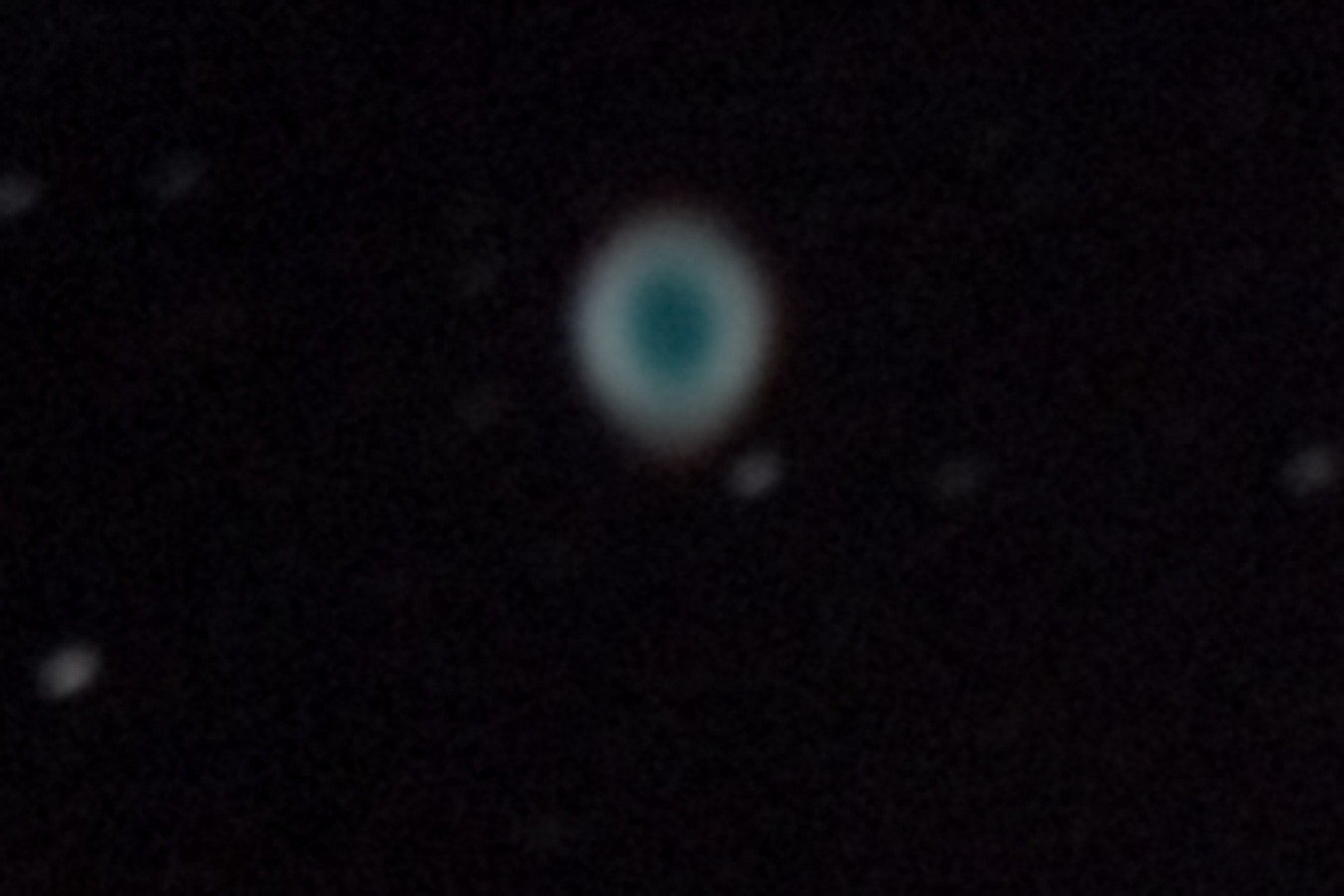
What my 150 mm telescope and a small camera got from a back garden, 3 October 2026. Ring Nebula in the diary Planetary nebula
Ring Nebula (M57)
The glowing remains of a star like the Sun, 2,000 light years away.
A moderately sized telescope shows the ring.
Best at 21:20, 25° up in the north-west, setting. Not forecast clear then. Above 25° from 18:25 to 21:20 (2.9 h) of the dark, with moonlight, but it's brighter than the moonlit sky at its best.
No time left tonight has it 30° up: this is the best of what’s left.
Next good chance: Sat 28 Nov, 18:20 to 20:25. No clear spell for it in the forecast yet.
Globular cluster
Angelfish Cluster (M71)
Classed as an open cluster for decades, this 27-light-year ball of stars 13,000 light years away was only accepted as a loose globular in the 1970s.
A faint patch in binoculars, beside 9 Sagittae; medium telescopes resolve it to the centre, brighter and sharp-edged on its western side.
Best at 21:20, 22° up in the west, setting. Not forecast clear then. Above 25° from 18:25 to 21:00 (2.6 h) of the dark, with moonlight, which matters less for stars at its best.
No time left tonight has it 30° up: this is the best of what’s left.
Next good chance: Sat 28 Nov, 18:20 to 20:10. No clear spell for it in the forecast yet.
Open cluster
h Persei Cluster NGC 869
One half of the Double Cluster: hundreds of young stars 7,500 light years away, only about 14 million years old.
To the eye, a hazy patch beside its twin in Perseus; any optical aid splits the pair into two fields of stars.
Best at 22:10, 86° up in the north-east, rising. Not forecast clear then. Above 25° from 18:25 to 06:10 (11.8 h) of the dark, with moonlight, which matters less for stars at its best.
Next good chance: Sat 28 Nov, 18:20 to 20:30. No clear spell for it in the forecast yet.
Open cluster
chi Persei Cluster NGC 884
One half of the Double Cluster: hundreds of young stars, about 14 million years old, 7,500 light years away.
The pair shows to the eye as one misty patch; any optical aid splits it into two clusters.
Best at 22:15, 86° up in the north-east, rising. Not forecast clear then. Above 25° from 18:25 to 06:10 (11.8 h) of the dark, with moonlight, which matters less for stars at its best.
Next good chance: Sat 28 Nov, 18:20 to 20:30. No clear spell for it in the forecast yet.
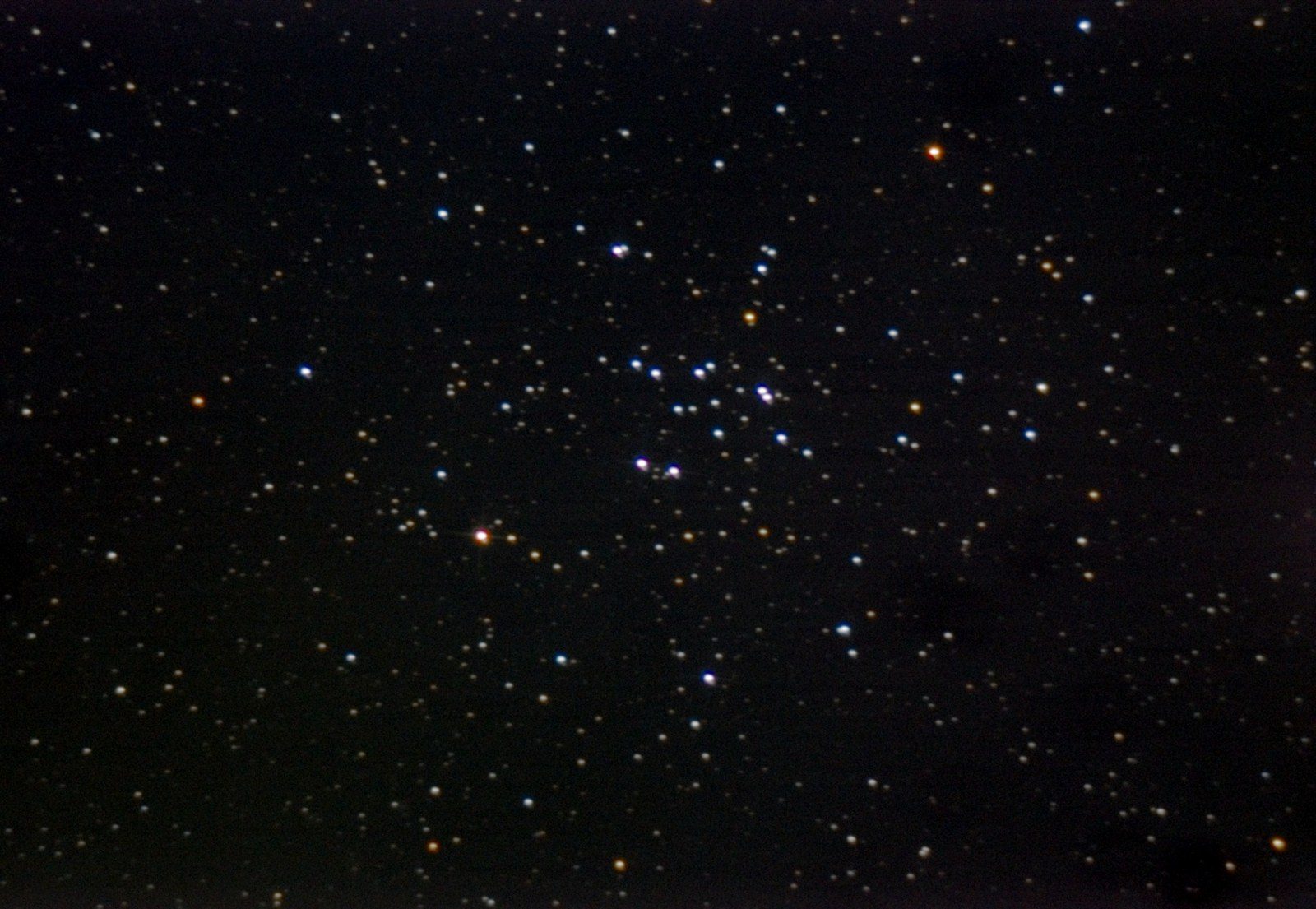
What my 150 mm telescope and a small camera got from a back garden, 29 October 2026. M34 in the diary Open cluster
M34
A cluster some 1,400 to 1,500 light years away whose stars' spin rates put its age at 240 million years, by a 2011 gyrochronology study.
A faint nebulous patch to the naked eye in good conditions, just north of the line from Algol to Gamma Andromedae; 10x50 binoculars resolve it, and larger amateur telescopes show about 80 stars.
Best at 22:55, 78° up in the south, near its highest. Not forecast clear then. Above 25° from 18:25 to 06:10 (11.8 h) of the dark, with moonlight, which matters less for stars at its best.
Next good chance: Sat 28 Nov, 18:20 to 20:30. No clear spell for it in the forecast yet.
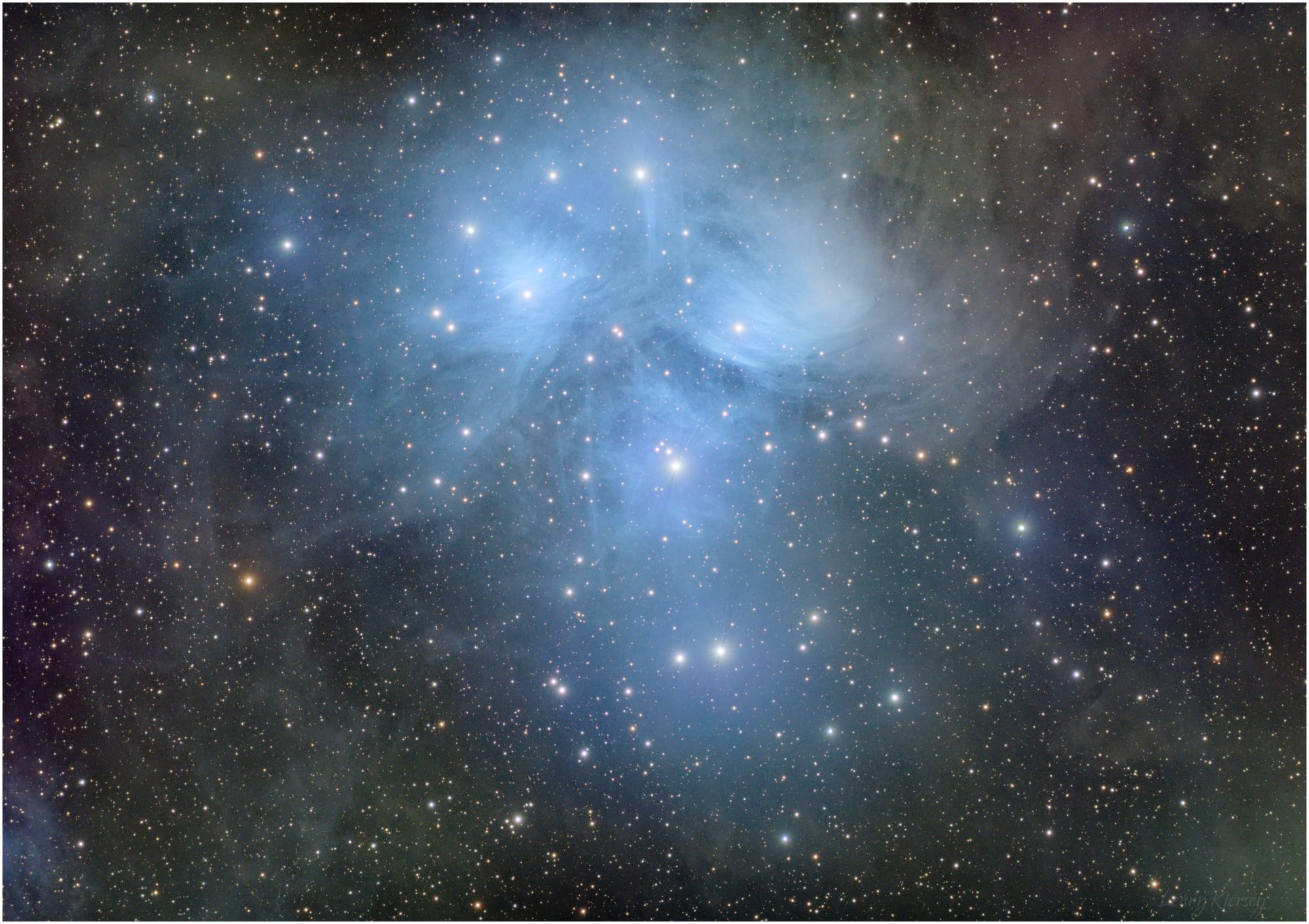
Sent in by Lenny Kiersey. All 2 pictures Open cluster
Pleiades (M45)
A family of young stars about 440 light years away, born together about 100 million years ago.
Six or seven stars to the eye; binoculars turn it into dozens.
Best at 01:10, 56° up in the south-west, setting. Not forecast clear then. Above 25° from 18:40 to 05:25 (10.8 h) of the dark, with moonlight, which matters less for stars at its best.
Next good chance: Sat 28 Nov, 19:00 to 20:30. No clear spell for it in the forecast yet.
Nebula
Foxface Nebula NGC 1788
A cloud of dust in a quiet corner of Orion, 1,300 light years away, lit by stars inside it and edged by a dark cloud.
Magnitude 9 and 5 arcminutes across; it shows best on camera.
Best at 01:25, 32° up in the south, near its highest. Not forecast clear then. Above 25° from 23:05 to 03:40 (4.6 h) of the dark, with moonlight, but it's brighter than the moonlit sky at its best.
Next good chance: Tue 1 Dec, 23:45 to 02:00. Beyond the forecast.
Open cluster
Starfish Cluster (M38)
An open cluster of about 100 stars, a few hundred million years old, sharing its patch of sky with NGC 1907, a cluster that simulations suggest was born elsewhere in the Galaxy and is passing by.
Binoculars show it in Auriga, 2.5 degrees north-west of M36; its brightest stars make a pattern like the Greek letter Pi, or Webb's "oblique cross", which Walter Scott Houston wrote "seems more pronounced with small instruments".
Best at 01:50, 71° up in the south, near its highest. Not forecast clear then. Above 25° from 19:15 to 06:10 (10.9 h) of the dark, with moonlight, which matters less for stars at its best.
Next good chance: Sun 29 Nov, 19:35 to 22:05. No clear spell for it in the forecast yet.
Open cluster
Pinwheel Cluster (M36)
A cluster of stars about 25 million years old, roughly 4,000 light years away, much like the Pleiades.
At the edge of naked-eye sight; binoculars show a small fuzzy patch with eight or ten stars; an 80 mm telescope shows about 15.
Best at 01:55, 69° up in the south, near its highest. Not forecast clear then. Above 25° from 19:35 to 06:10 (10.6 h) of the dark, with moonlight, which matters less for stars at its best.
Next good chance: Sun 29 Nov, 19:50 to 22:05. No clear spell for it in the forecast yet.
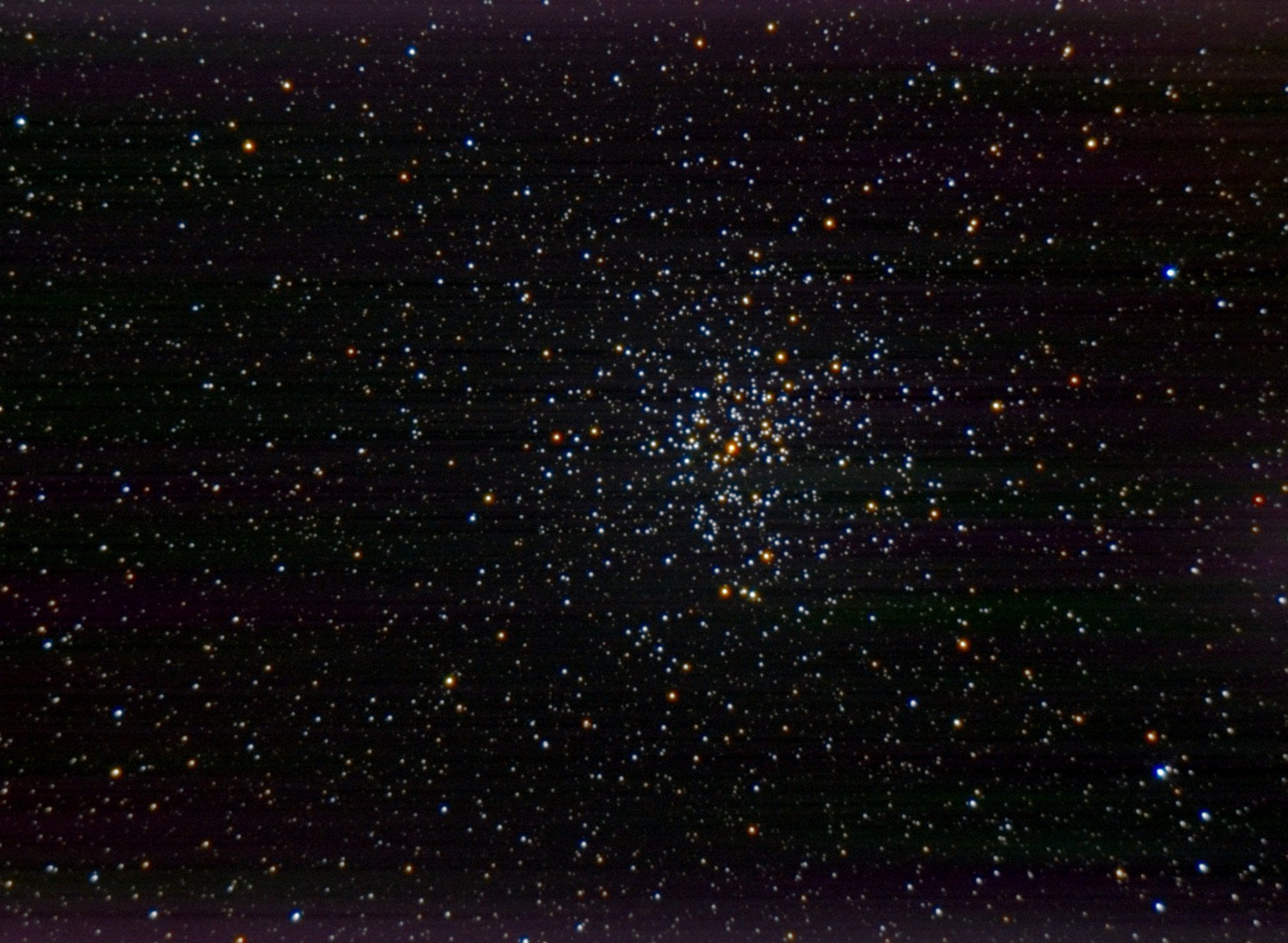
What my 150 mm telescope and a small camera got from a back garden, 18 October 2026. M37 in the diary Open cluster
Salt and Pepper Cluster (M37)
The richest cluster in Auriga: about 150 bright stars in a patch nearly a full Moon wide, 4,500 light years away.
Just visible to the eye in a dark sky; a misty patch in binoculars; a 6-inch telescope shows 25 to 40 stars.
Best at 02:15, 67° up in the south, near its highest. Not forecast clear then. Above 25° from 20:00 to 06:10 (10.2 h) of the dark, with moonlight, which matters less for stars at its best.
Next good chance: Sun 29 Nov, 20:15 to 22:05. No clear spell for it in the forecast yet.
Open cluster
"37" NGC 2169
Its brighter stars happen to spell out the number 37, and the cluster is about 11 million years old by a 2013 estimate.
A small group about 6 to 7 arcminutes across, 5.9 magnitude in total; in a telescope the brighter stars form a "3" and a "7" side by side.
Best at 02:30, 49° up in the south, near its highest. Not forecast clear then. Above 25° from 22:00 to 06:10 (8.2 h) of the dark, with moonlight, which matters less for stars at its best.
Next good chance: Tue 1 Dec, 22:05 to 04:30. Beyond the forecast.
Open cluster
Shoe-Buckle Cluster (M35)
A cluster of several hundred stars around 100 to 150 million years old, about 2,800 light years away.
A fuzzy spot to the eye on a very dark night; binoculars show a haze with some stars; a telescope shows a field of bright stars.
Best at 02:35, 59° up in the south, near its highest. Not forecast clear then. Above 25° from 21:00 to 06:10 (9.2 h) of the dark, with moonlight, which matters less for stars at its best.
Next good chance: Mon 30 Nov, 21:15 to 00:25. No clear spell for it in the forecast yet.
Open cluster
Great Bird Cluster NGC 2301
One of the clusters in a Chandra study, released in 2026, in which Sun-like stars older than about 100 million years gave out a quarter to a third of the X-rays the researchers expected.
Visible in 7x50 binoculars, about 12 arcminutes across; its brightest star, an orange subgiant of magnitude 8.0, may be a foreground star rather than a member.
Best at 03:20, 35° up in the south, near its highest. Not forecast clear then. Above 25° from 00:15 to 06:00 (5.8 h) of the dark, with moonlight, which matters less for stars at its best.
Next good chance: Tue 1 Dec, 00:35 to 02:50. Beyond the forecast.
Open cluster
Broken Heart Cluster NGC 2281
An Auriga cluster about 528 parsecs away and 630 to 661 million years old by a 2021 study, which William Herschel had already seen in 1782, six years before he catalogued it.
Magnitude 5.4, spread over 18 to 25 arcminutes; Dreyer's catalogue calls it a pretty rich cluster of pretty large stars, very little compressed.
Best at 03:35, 75° up in the south-west, setting. Not forecast clear then. Above 25° from 20:00 to 06:10 (10.2 h) of the dark, with moonlight, which matters less for stars at its best.
Next good chance: Sun 29 Nov, 20:25 to 22:05. No clear spell for it in the forecast yet.
Globular cluster
M3
The first object Charles Messier discovered himself (3 May 1764), and home to more RR Lyrae stars than any other globular: 241 of its 267 confirmed variables.
At the edge of naked-eye visibility in very good skies; a hazy patch in binoculars, a bright core in a mottled glow in a 4-inch, resolved to the core in about a 12-inch.
Best at 06:05, 42° up in the east, rising. Not forecast clear then. Above 25° from 04:10 to 06:10 (2 h) of the dark, with moonlight, which matters less for stars at its best.
Next good chance: Thu 3 Dec, 04:10 to 06:20. Beyond the forecast.
Double star
M40
Not a nebula or even a true double: two unrelated stars, one about 1,000 light years away and the other about 470, that Messier logged in 1764 while hunting a nebula that was never there.
Two stars of magnitude 9.6 and 10.1, about 52 arcseconds apart, 16 arcminutes north-east of 70 Ursae Majoris.
Best at 06:05, 70° up in the north-east, rising. Not forecast clear then. Above 25° from 22:20 to 06:10 (7.8 h) of the dark, with moonlight, which matters less for stars at its best.
Next good chance: Tue 1 Dec, 23:30 to 03:20. Beyond the forecast.
Open cluster
Beehive (M44)
About 1,000 stars 600 light years away, 600 to 700 million years old.
A blur of light to the eye; binoculars show about 20 stars; a telescope shows hundreds.
Best at 06:05, 52° up in the south-west, setting. Not forecast clear then. Above 25° from 00:00 to 06:10 (6.2 h) of the dark, with moonlight, which matters less for stars at its best.
Next good chance: Wed 2 Dec, 00:00 to 06:20. Beyond the forecast.
Open cluster
King Cobra Cluster (M67)
About 4 billion years old, close to the Sun's age, it is the oldest open cluster in Messier's catalogue and holds more than 100 Sun-like stars.
A faint patch in binoculars; telescopes resolve from a few up to about 100 of its stars.
Best at 06:05, 45° up in the south, setting. Not forecast clear then. Above 25° from 00:55 to 06:10 (5.2 h) of the dark, with moonlight, which matters less for stars at its best.
Next good chance: Wed 2 Dec, 01:00 to 06:20. Beyond the forecast.
Globular cluster
M92
One of the oldest globular clusters in the galaxy, put at 13.8 billion years old by a 2023 study, 26,700 light years away and overlooked because M13 is so close by in the sky.
Visible to the naked eye from a dark site in good conditions; a small telescope shows a nebulous smudge even under heavy light pollution, and darker skies let it resolve into stars.
Best at 06:05, 24° up in the north-east, rising. Not forecast clear then. Above 25° from 18:25 to 20:50 (2.4 h) of the dark, with moonlight, which matters less for stars at its best.
No time left tonight has it 30° up: this is the best of what’s left.
Next good chance: Sat 28 Nov, 18:20 to 19:50. No clear spell for it in the forecast yet.
Planetary nebula
Cat's Eye Nebula NGC 6543
A dying star's shells, thrown off in bursts about 1,500 years apart, about 3,000 light years away.
A telescope shows a small bright disc; looking slightly to one side brings out the faint gas round it.
Best at 06:05, 40° up in the north-east, rising. Not forecast clear then. Above 25° from 18:25 to 06:10 (11.8 h) of the dark, with moonlight, but it's brighter than the moonlit sky at its best.
Next good chance: Sat 28 Nov, 18:20 to 20:30. No clear spell for it in the forecast yet.
Open cluster
Brocchi's Cluster Cl399
Ten stars of 5th to 7th magnitude in the shape of a coathanger, whose Gaia DR3 distances run from about 235 to 1,735 light years, so the shape is a chance line-up and not a cluster.
Under a dark sky the eye sees an unresolved patch; binoculars or a telescope at very low power show a straight row of six stars with a hook of four on its south side.
Was best at 18:25, 43° up in the south-west. Above 25° from 18:25 to 20:40 (2.2 h) of the dark, with moonlight, which matters less for stars at its best.
Next good chance: Sat 28 Nov, 18:20 to 19:50. No clear spell for it in the forecast yet.
Globular cluster
M2
About 150,000 stars in a ball 175 light years across, 38,000 light years away, on an orbit that swings from 2,900 to 61,000 light years from the Galactic centre.
Just below naked-eye visibility in average skies but easy in binoculars in a star-poor field; a 4-inch shows a mottled glow with a few stars, an 8-inch partly resolves it, well into the centre in good seeing.
Was best at 18:25, 34° up in the south. Above 25° from 18:25 to 20:30 (2.1 h) of the dark, with moonlight, which matters less for stars at its best.
Next good chance: not in the next month
The same list as a table
| Object | Best | Where | Above 25° in the dark | Next good chance |
|---|---|---|---|---|
| Venus · planet | 07:30 | 20° south-east | – | tonight |
| Mars · planet | 06:20 | 48° south | – | tonight |
| Jupiter · planet | 06:05 | 48° south | – | tonight |
| Saturn · planet | 21:20 | 35° south | – | tonight |
| Northern Taurids · meteor shower, peak 12 November | 18:20 to 05:45 | the whole sky | – | tonight |
| Leonids · meteor shower, peak 17 November | 00:35 to 06:45 | the whole sky | – | tonight |
| Alpha Monocerotids · meteor shower, peak 22 November | 00:20 to 06:45 | the whole sky | – | tonight |
| M103 · open cluster | 21:20 | 83° north-east | 18:25 to 06:10 (11.8 h) | Sat 28 Nov, 18:20 to 20:30no clear spell for it in the forecast yet |
| Great Pegasus Cluster (M15) · globular | 21:20 | 30° south-west | 18:25 to 22:00 (3.6 h) | Sat 28 Nov, 18:20 to 20:30no clear spell for it in the forecast yet |
| Cooling Tower Cluster (M29) · open cluster | 21:20 | 41° west | 18:25 to 23:25 (5 h) | Sat 28 Nov, 18:20 to 20:30no clear spell for it in the forecast yet |
| M39 · open cluster | 21:20 | 57° west | 18:25 to 01:45 (7.3 h) | Sat 28 Nov, 18:20 to 20:30no clear spell for it in the forecast yet |
| Scorpion Cluster (M52) · open cluster | 21:20 | 75° north-west | 18:25 to 06:10 (11.8 h) | Sat 28 Nov, 18:20 to 20:30no clear spell for it in the forecast yet |
| M56 · globular | 21:20 | 26° west | 18:25 to 21:25 (3 h) | Sat 28 Nov, 18:20 to 20:30no clear spell for it in the forecast yet |
| Ring Nebula (M57) · planetary nebula | 21:20 | 25° north-west | 18:25 to 21:20 (2.9 h) | Sat 28 Nov, 18:20 to 20:25no clear spell for it in the forecast yet |
| Angelfish Cluster (M71) · globular | 21:20 | 22° west | 18:25 to 21:00 (2.6 h) | Sat 28 Nov, 18:20 to 20:10no clear spell for it in the forecast yet |
| h Persei Cluster NGC 869 · open cluster | 22:10 | 86° north-east | 18:25 to 06:10 (11.8 h) | Sat 28 Nov, 18:20 to 20:30no clear spell for it in the forecast yet |
| chi Persei Cluster NGC 884 · open cluster | 22:15 | 86° north-east | 18:25 to 06:10 (11.8 h) | Sat 28 Nov, 18:20 to 20:30no clear spell for it in the forecast yet |
| M34 · open cluster | 22:55 | 78° south | 18:25 to 06:10 (11.8 h) | Sat 28 Nov, 18:20 to 20:30no clear spell for it in the forecast yet |
| Pleiades (M45) · open cluster | 01:10 | 56° south-west | 18:40 to 05:25 (10.8 h) | Sat 28 Nov, 19:00 to 20:30no clear spell for it in the forecast yet |
| Foxface Nebula NGC 1788 · nebula | 01:25 | 32° south | 23:05 to 03:40 (4.6 h) | Tue 1 Dec, 23:45 to 02:00beyond the forecast |
| Starfish Cluster (M38) · open cluster | 01:50 | 71° south | 19:15 to 06:10 (10.9 h) | Sun 29 Nov, 19:35 to 22:05no clear spell for it in the forecast yet |
| Pinwheel Cluster (M36) · open cluster | 01:55 | 69° south | 19:35 to 06:10 (10.6 h) | Sun 29 Nov, 19:50 to 22:05no clear spell for it in the forecast yet |
| Salt and Pepper Cluster (M37) · open cluster | 02:15 | 67° south | 20:00 to 06:10 (10.2 h) | Sun 29 Nov, 20:15 to 22:05no clear spell for it in the forecast yet |
| "37" NGC 2169 · open cluster | 02:30 | 49° south | 22:00 to 06:10 (8.2 h) | Tue 1 Dec, 22:05 to 04:30beyond the forecast |
| Shoe-Buckle Cluster (M35) · open cluster | 02:35 | 59° south | 21:00 to 06:10 (9.2 h) | Mon 30 Nov, 21:15 to 00:25no clear spell for it in the forecast yet |
| Great Bird Cluster NGC 2301 · open cluster | 03:20 | 35° south | 00:15 to 06:00 (5.8 h) | Tue 1 Dec, 00:35 to 02:50beyond the forecast |
| Broken Heart Cluster NGC 2281 · open cluster | 03:35 | 75° south-west | 20:00 to 06:10 (10.2 h) | Sun 29 Nov, 20:25 to 22:05no clear spell for it in the forecast yet |
| M3 · globular | 06:05 | 42° east | 04:10 to 06:10 (2 h) | Thu 3 Dec, 04:10 to 06:20beyond the forecast |
| M40 · double star | 06:05 | 70° north-east | 22:20 to 06:10 (7.8 h) | Tue 1 Dec, 23:30 to 03:20beyond the forecast |
| Beehive (M44) · open cluster | 06:05 | 52° south-west | 00:00 to 06:10 (6.2 h) | Wed 2 Dec, 00:00 to 06:20beyond the forecast |
| King Cobra Cluster (M67) · open cluster | 06:05 | 45° south | 00:55 to 06:10 (5.2 h) | Wed 2 Dec, 01:00 to 06:20beyond the forecast |
| M92 · globular | 06:05 | 24° north-east | 18:25 to 20:50 (2.4 h) | Sat 28 Nov, 18:20 to 19:50no clear spell for it in the forecast yet |
| Cat's Eye Nebula NGC 6543 · planetary nebula | 06:05 | 40° north-east | 18:25 to 06:10 (11.8 h) | Sat 28 Nov, 18:20 to 20:30no clear spell for it in the forecast yet |
| Brocchi's Cluster Cl399 · open cluster | was 18:25 | 43° south-west | 18:25 to 20:40 (2.2 h) | Sat 28 Nov, 18:20 to 19:50no clear spell for it in the forecast yet |
| M2 · globular | was 18:25 | 34° south | 18:25 to 20:30 (2.1 h) | not in the next month |
951 catalogue objects climb above 20° in the dark tonight. These 28 are the showpieces among them (Messier’s list, Gary Imm’s top rating, or named and brighter than magnitude 6) that are well placed: 30° or more up at their best, above 25° for 2 hours or more of the dark, and, star clusters aside, with no more moonlight than a dark sky’s own unless they’re brighter than the moonlit sky. There’s no set number: a moonlit night has fewer. They’re in the order of the night, each at its best time. Cloud doesn’t change the list: it’s the same sky for all of them, and the forecast above says what it’ll be. Nothing here says what equipment you need. Chosen partly by Gary Imm’s ratings in his Deep Sky Compendium (2026, 6th edition). Objects from OpenNGC (CC BY-SA 4.0), with a few corrections.
All 654 objects: what each one is, and every picture sent in
The next seven nights
| Night | Longest clear spell | Moon | Galaxies | Star clusters | Planets | Forecasts |
|---|---|---|---|---|---|---|
| Tue 24 | none | 100%, 11.8 h in the dark | Poor | Poor | Poor | all 4 forecasting centres agree |
| Wed 25 | none | 97%, 11.8 h in the dark | Possible | Possible | Possible | best hour: 2 of 4 forecasts clear |
| Thu 26 | none | 92%, 11.8 h in the dark | Poor | Poor | Poor | all 4 forecasting centres agree |
| Fri 27 | none | 84%, 11.2 h in the dark | Possible | Possible | Possible | best hour: 2 of 4 forecasts clear |
| Sat 28 | none | 74%, 9.8 h in the dark | Possible | Possible | Possible | best hour: 1 of 4 forecasts clear |
| Sun 29 | none | 64%, 8.2 h in the dark | Possible | Possible | Possible | best hour: 2 of 4 forecasts clear · a rough guide |
| Mon 30 | none | 53%, 6.7 h in the dark | Poor | Poor | Poor | every centre that could decide agrees, 3 to 4 of them an hour · a rough guide |
Coming up
The next 30 days
- 24 Nov 12:00 The Moon covers Pleiades (Alcyone) not visible from here Until about 12:25. the Moon is below the horizon
- 24 Nov 14:53 Full Moon visible from here Bright moonlight all night: a poor week for faint galaxies, fine for the Moon itself.
- 25 Nov 22:40 Uranus at opposition visible from here Best seen 26 Nov 00:15. Up for nearly all of the 15 hours of darkness here and near its biggest and brightest for the year.
- 30 Nov 08:00 The Moon and Jupiter close together visible from here Best seen 30 Nov 05:35. 2.1 degrees apart, in the south; closest, 1.8 degrees, 2 hours later
- 2 Dec Phoenicids not visible from here the radiant doesn't climb above 20 degrees in darkness from here
- 7 Dec Puppid-Velids not visible from here the radiant doesn't climb above 20 degrees in darkness from here
- 9 Dec 00:51 New Moon visible from here No moonlight: the darkest nights of the month for faint things.
- 9 Dec Sigma Hydrids visible from here up to about 4 an hour at the peak from here under a dark, clear sky; the peak itself is in daylight here, so watch the nights either side; watch 23:50 to 07:00 the next morning, or 23:50 to 07:00 the next morning
- 14 Dec 14:00 Geminids visible from here up to about 139 an hour at the peak from here under a dark, clear sky; the peak itself is in daylight here, so watch the nights either side; watch 19:30 to 07:10 the next morning, or 19:40 to 07:10 the next morning
- 22 Dec Ursids visible from here up to about 9 an hour at the peak from here under a dark, clear sky; the peak itself is in daylight here, so watch the nights either side; watch 17:40 to 07:10 the next morning, or 17:40 to 07:10 the next morning
- 24 Dec 01:28 Full Moon visible from here Bright moonlight all night: a poor week for faint galaxies, fine for the Moon itself.
Later this year
- 4 Jan 03:25 Quadrantids visible from here up to about 77 an hour at the peak from here under a dark, clear sky; watch 23:45 to 07:15 the next morning
- 6 Feb 15:59 Annular solar eclipse local visibility not checked whether you're in the eclipse's zone isn't worked out yet NASA map
- 20 Feb 23:12 Penumbral lunar eclipse visible from here The Moon is up for all of it. A penumbral eclipse is only a faint shading of the Moon.
- 18 Jul 17:02 Penumbral lunar eclipse not visible from here the Moon is below the horizon for all of it
- 2 Aug 11:06 Total solar eclipse local visibility not checked whether you're in the eclipse's zone isn't worked out yet NASA map
- 17 Aug 08:13 Penumbral lunar eclipse local visibility not checked the Moon is right on the horizon then
Subscribe to these in your calendar, or in Google Calendar, or copy its address: https://meanwhileinspace.com/events.ics?at=55.1,-6.5. A subscribed calendar updates itself, when the app chooses to check (a feed for this rounded spot; big events only, never weather windows). Showers from the 2026 and 2027 IMO calendars; eclipses from NASA; the rest worked out here.
Worth knowing about
Exploding stars
- SN 2026ahvu in NGC 1433, type Ia: magnitude 11.9 on 2026-11-19 (it peaked at 11.9). Not up in the dark from here tonight.
- SN 2026ahvi in NGC 4189, type Ia: magnitude 12.5 on 2026-11-11 (it peaked at 12.5). Up from here tonight: best at 06:05, 40° up. A job for a camera on a telescope.
- SN 2026sqf in NGC 3310, type Ia-CSM: magnitude 13.3 on 2026-11-03 (it peaked at 11.2). Up from here tonight: best at 06:05, 83° up. A job for a camera on a telescope.
- SN 2026aaiv in NGC 7331, type Ia: magnitude 15.3 on 2026-11-18 (it peaked at 11.5). Up from here tonight: best at 21:20, 57° up. A job for a camera on a telescope.
- SN 2026ainb in UGC 3486, type Ia: magnitude 15.5 on 2026-11-21 (it peaked at 15.5). Up from here tonight: best at 02:50, 71° up. A job for a camera on a telescope.
From the Rochester list of bright supernovae.
Stars that need watching
197 AAVSO alerts and campaigns are up in the dark from here tonight. They want measurements, usually with a camera and filters.
- RR Lyn (EA/DM) · priority: wanted in B, I, R, Spectroscopy, V, every 3 days. Alert Notice 859 https://www.aavso.org/aavso-alert-notice-859
- J0139 (E+ZZA) · priority: wanted in B, V, every 3 days. Alert Notice 680 https://www.aavso.org/aavso-alert-notice-680
- GOTO065054.49+593624.51 (UGWZ) · priority: wanted in V, every 3 days
- V347 Aur (TTS) · priority: wanted in B, I, R, V, Visual, every 3 days. Alert Notice 830 https://www.aavso.org/aavso-alert-notice-830; Alert Notice 759 https://www.aavso.org/aavso-alert-notice-759
- HD 80606 (EP) · priority: wanted in V, every 3 days. Alert Notice 755 https://www.aavso.org/aavso-alert-notice-755
From the AAVSO Target Tool.
Comets
- 107P/Wilson-Harrington, COBS lists it at magnitude 8.8, with no observation reported in the last 10 days: not up in the dark from here tonight. 0 estimates this week: not enough to say.
- P/2016 BA14 (PANSTARRS), COBS lists it at magnitude 12.0, with no observation reported in the last 10 days: not up in the dark from here tonight. 0 estimates this week: not enough to say.
From COBS, positions from JPL Horizons.
Elsewhere in the universe…
Recent astronomy news from Universe Today, AAS Nova and the BAA, from the last fortnight. Each links to the full story; the words quoted are theirs.
Bacteria and Nuclear Power Could Grow Ready-Made Homes on Mars Before Astronauts Arrive
“As we gear up to eventually land a human on Mars, more and more ideas are coming out about how to prepare for that. A recent one from Pioneer Labs, a research institute founded by bioengineer Erika DeBenedictis to develop biological technologies for space exploration, is now available on arXiv, without any plans to release it in a paid journal as part of…”
Space Entrepreneurs Should Look To 16th Century Spice Trade For Inspiration
“In the short term, human exploration of the Moon and Mars seems practical, but for the next 50 years at least, robotic exploration may be the most cost-effective and efficient. Human exploration…”
Observer’s Challenge – Planet Parade, November 14
“On the pre-dawn sky of November 14th the planets Mercury, Venus, Jupiter, and Mars will be visible in the east”
A Dark Energy Camera Portrait of the Betta Fish Nebula
“The Betta Fish Nebula is a supernova remnant almost 7,000 light years away. It consists of the cast off layers of a star that exploded as a supernova. When those layers slammed into the interstellar…”
UK-Built X-Ray Telescope Ready For Action at Mercury
“The joint ESA/JAXA BepiColombo mission has arrived at Mercury, and among its arsenal of detectors ready to explore the innermost world is an innovative new instrument. A University of Leicester team…”
My telescope, in Ballymoney, Northern Ireland
From its own planner: Staying in. Watch it live when it’s imaging.
Worked out for Ballymoney at 21:19 on 24 November in 1.36 s.
What happens to your place: it’s rounded to 0.1° before anything is worked out. The rounded spot goes to Open-Meteo and Meteosource for the forecasts and to EUMETSAT’s map service for the satellite line, and, rounded to a whole degree, to 7Timer for the seeing; a place you type goes to Open-Meteo’s search to find it. This server keeps the pages and forecasts it made for rounded spots for up to three days, and the places it has looked up, so the next person asking is answered faster. Its visitor logs record your connection’s address and the page, not the place. It also counts each page view by day and country, with the town your connection appears to be in when the page guessed your sky, and how long the page took: no address, and never a place you typed or chose. Google Analytics counts visits: it gets the page’s address with the place taken out, but the page’s title, which names the rounded place, goes with it.
Other skies
The same page for Belfast and Dublin, or anywhere else: type a town or city and it works it out for there.