Moon
Is it up tonight? Meanwhile works it out for your sky
Pictures sent in
Through Send me your picture, newest first, each credited to whoever took it. Stats for nerds is what they told us about how they took it.
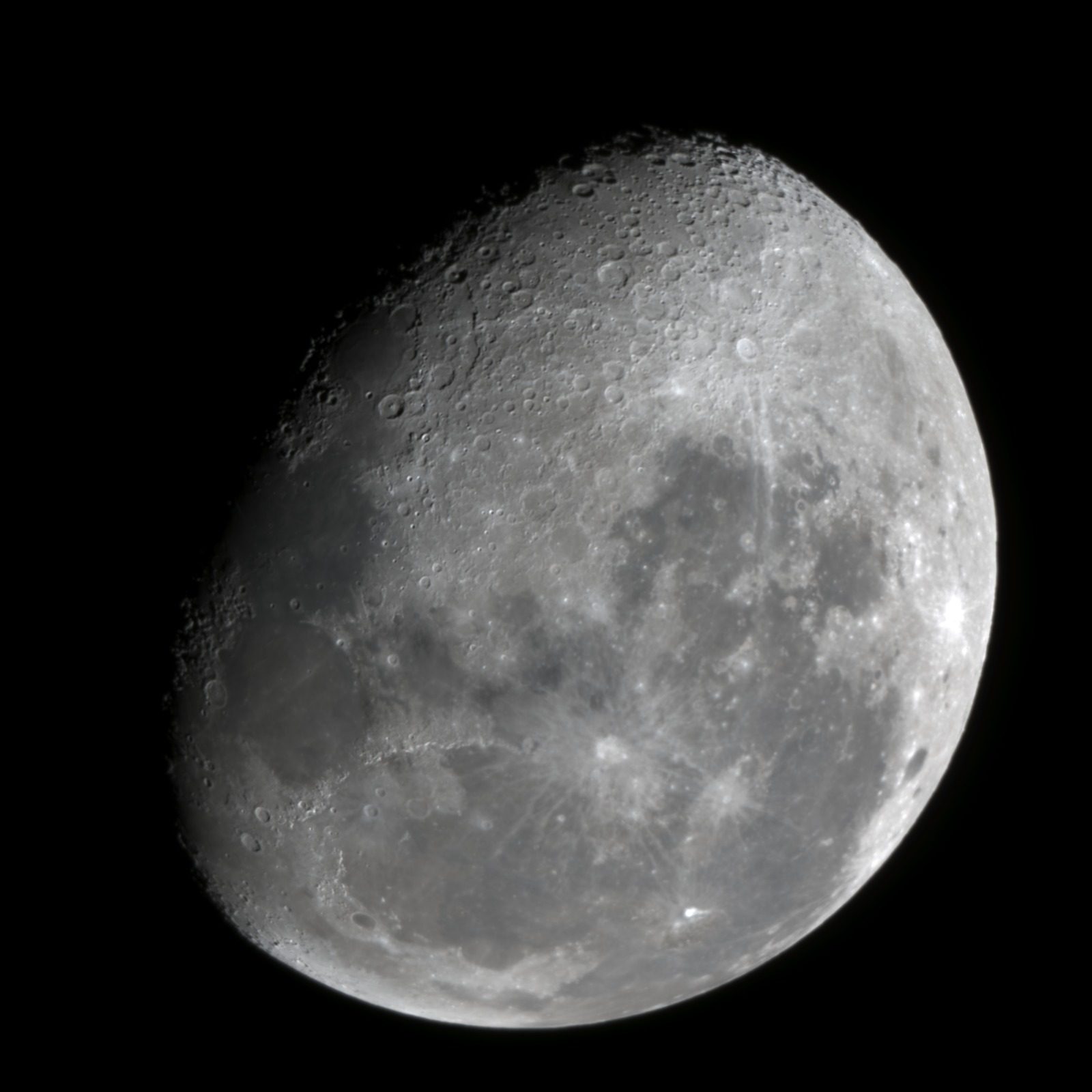
Waning gibbous Moon
by Ryan Clinton · 30 October 2026, 02:18 GMT
Stats for nerds
- Telescope
- Sky-Watcher Explorer 150P Newtonian, 150 mm f/5, 750 mm focal length. No Barlow, no corrector.
- Mount
- Sky-Watcher EQ3 Pro with its SynScan handset, driven over USB by TelescopeYoke. Unguided: the Moon is found in the picture and re-centred between bursts.
- Camera
- Altair Hypercam 183C (Sony IMX183, colour, uncooled). Gain 100, 7.2 ms per frame, 8-bit video, a 3488 × 3488 region round the disc.
- Filters
- None. The detail is taken from the camera's green pixels.
- Accessories
- An Ubuntu laptop beside the telescope running TelescopeYoke, which plans the night and drives the mount, camera and stacking.
- Exposures
- One video of 495 frames of 7.2 ms, in two bursts of about a minute at 4 frames a second, with the Moon re-centred between them. No frames dropped. The best 40% (198 frames) were stacked.
- Calibration
- None.
- Sky
- Waning gibbous Moon, 80% lit, 57° up, 360,100 km away.
- Capture software
- TelescopeYoke, my own open-source Python software (github.com/Ryan-Clinton/telescopeyoke), with Altair's camera library.
- Processing software
- TelescopeYoke's own lucky-imaging code (Python: numpy, scipy, astropy). No AutoStakkert, RegiStax or Photoshop.
- Processing
- Lucky imaging in TelescopeYoke. Frames were graded patch by patch and the best 40% kept. Each was lined up as a whole and then on 600 alignment points, stacked, and then sharpened.
- Notes
- The same morning as my mineral Moon. TelescopeYoke found the disc in the picture and centred it itself, and set the exposure from the brightness of the surface.
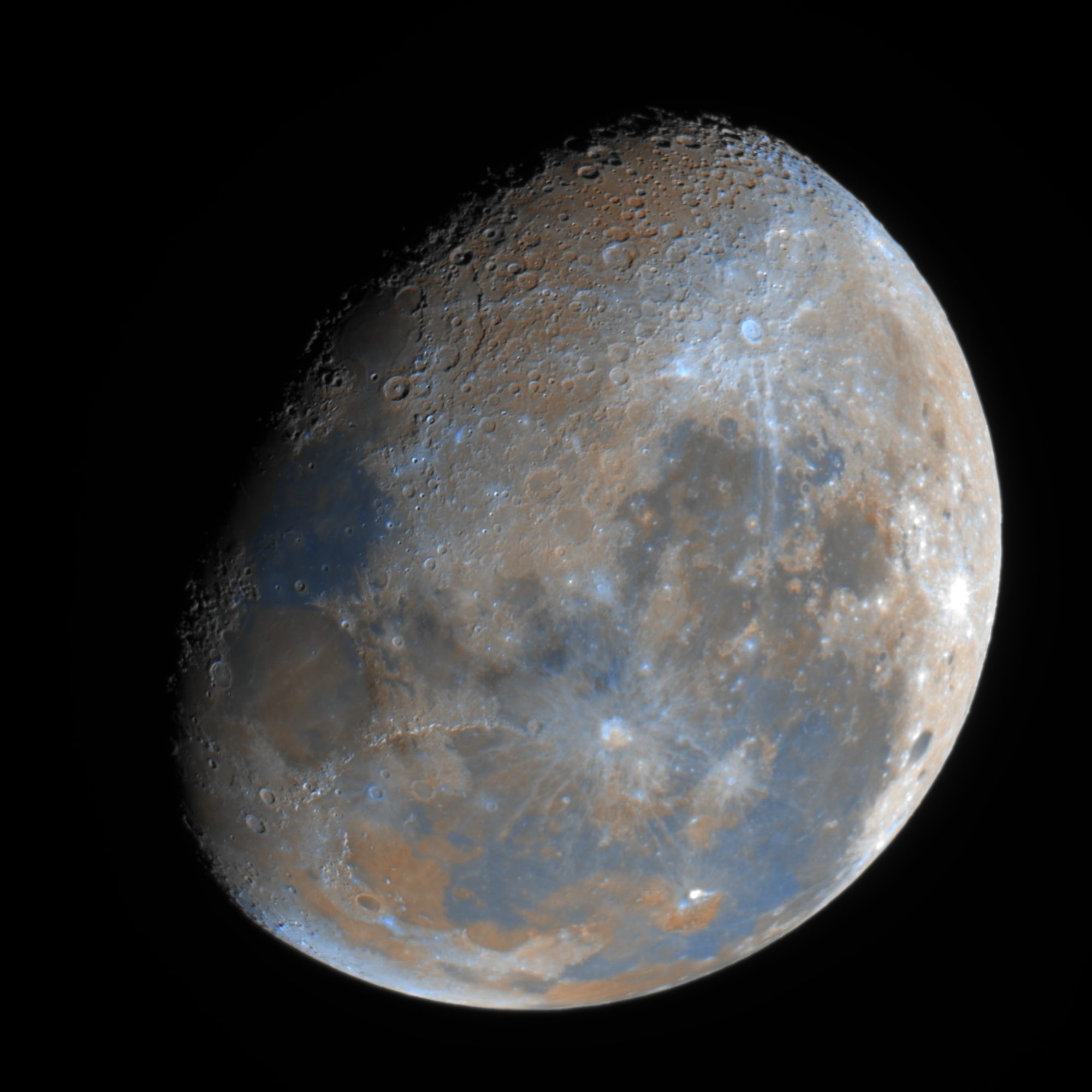
Mineral Moon
by Ryan Clinton · Night of 29 to 30 October 2026, 01:55 to 02:20 GMT
Stats for nerds
- Telescope
- Sky-Watcher Explorer 150P Newtonian, 150 mm f/5, 750 mm focal length. No Barlow, no corrector.
- Mount
- Sky-Watcher EQ3 Pro with its SynScan handset, driven over USB by TelescopeYoke. Unguided: the Moon is found in the picture and re-centred between bursts.
- Camera
- Altair Hypercam 183C (Sony IMX183, colour, uncooled). Gain 100, about 7 ms per frame, 8-bit video, a 3488 × 3488 region round the disc.
- Filters
- None: the camera's own red, green and blue pixels (roughly 625, 530 and 460 nm, broad).
- Accessories
- An Ubuntu laptop beside the telescope running TelescopeYoke, which plans the night and drives the mount, camera and stacking.
- Exposures
- Three videos: 1018, 1000 and 495 frames of about 7 ms (8-bit SER), at about 4 frames a second. All three were used for both the colour and the detail.
- Calibration
- None. No flat for these videos.
- Sky
- Waning gibbous Moon, 80% lit, 57° up.
- Capture software
- TelescopeYoke, my own open-source Python software (github.com/Ryan-Clinton/telescopeyoke), with Altair's camera library.
- Processing software
- TelescopeYoke's own lucky-imaging and mineral-Moon code (Python: numpy, scipy, astropy). No PixInsight, Siril, AutoStakkert or Photoshop.
- Processing
- Lucky imaging, then colour. Each video's frames were graded patch by patch, and the sharpest were kept. They were lined up first as a whole and then on 600 alignment points, stacked and sharpened.
For the colour, the three colour stacks were balanced and clipped areas left out. Colour was measured as log ratios on 2×2 blocks, and the slope of colour across the disc (which follows the lighting, not the rocks) was fitted and taken off. Colour that didn't repeat from one video to the next was turned down. What was left was turned up 15 times.
Checks: Mare Tranquillitatis comes out bluer than Mare Serenitatis by 2.0% in all three videos, and with any one video left out. The orientation found from the picture matched a plate solve that night to 0.1°. Against Clementine's spacecraft colour map the rank correlation is 0.38, so the blue and brown are in the right places but the strength is only roughly right. - Notes
- My first mineral Moon. It was done with 8-bit video and no flat, and the first of the three videos was overexposed. TelescopeYoke now takes 16-bit video with flats for the next one.