Star clusters tonight
Every star cluster worth a look that’s well placed tonight, in the order of the night.
Star clusters over Columbus, US, Tuesday 24 November
- Properly dark from 6:50 pm to 5:55 am.
- The Moon is 99% lit: up for 11.1 hours of the dark.
Whether it’ll be clear is on the main page, with the forecast hour by hour.
Open cluster
M103
The last object Messier added to his catalogue: about 170 stars 9,400 light years away, 13 to 25 million years old.
Binoculars or a small telescope show a fan-shaped patch, 6 arcminutes across, near the end of Cassiopeia's W.
Best at 6:50 pm, 55° up in the north-east, rising. Not enough centres call it clear then. Forecast clear and above 25° from 4:30 am to 5:20 am; moonlight matters less for stars. Above 25° from 6:50 pm to 5:20 am (10.5 h) of the dark, with moonlight, which matters less for stars at its best.
Next good chance: Fri 27 Nov, 6:45 pm to 8:30 pm. No clear spell for it in the forecast yet.
Globular cluster
Great Pegasus Cluster (M15)
One of the densest globulars known, with a collapsed core 1.4 light years across, 15 pulsars by 2025, and Pease 1, the first planetary nebula found in a globular (1928).
At the naked-eye limit in very good conditions; a round nebulous object in small binoculars, a mottled glow in a 4-inch, and larger telescopes resolve the outer parts while the core stays unresolved.
Best at 6:50 pm, 59° up in the south-west, setting. Not enough centres call it clear then. Above 25° from 6:50 pm to 10:20 pm (3.5 h) of the dark, with moonlight, which matters less for stars at its best.
Next good chance: Fri 27 Nov, 6:45 pm to 8:30 pm. No clear spell for it in the forecast yet.
Globular cluster
M2
About 150,000 stars in a ball 175 light years across, 38,000 light years away, on an orbit that swings from 2,900 to 61,000 light years from the Galactic centre.
Just below naked-eye visibility in average skies but easy in binoculars in a star-poor field; a 4-inch shows a mottled glow with a few stars, an 8-inch partly resolves it, well into the centre in good seeing.
Best at 6:50 pm, 47° up in the south, setting. Not enough centres call it clear then. Above 25° from 6:50 pm to 9:35 pm (2.8 h) of the dark, with moonlight, which matters less for stars at its best.
Next good chance: Fri 27 Nov, 6:45 pm to 8:30 pm. No clear spell for it in the forecast yet.
Open cluster
Cooling Tower Cluster (M29)
A young cluster behind thick Cygnus dust, whose distance has been given as anything from 4,000 to 7,200 light years; a 2014 study put it at about 5,000.
A small group in binoculars 1.7 degrees south of Gamma Cygni; at low power its brightest stars make a quadrilateral and a small triangle, the "cooling tower" or Mallas's "stubby dipper".
Best at 6:50 pm, 65° up in the west, setting. Not enough centres call it clear then. Above 25° from 6:50 pm to 10:35 pm (3.8 h) of the dark, with moonlight, which matters less for stars at its best.
Next good chance: Fri 27 Nov, 6:45 pm to 8:30 pm. No clear spell for it in the forecast yet.
Open cluster
M39
A loose cluster about 300 parsecs away, spread over half a degree, whose age a 2023 spectroscopic study put at 430 million years against the 230 to 300 million of older estimates.
Just glimpsed by the unaided eye in good conditions; a 7x50 binocular resolves it into a triangle with a star at each corner and about 25 fainter stars inside.
Best at 6:50 pm, 76° up in the north-west, setting. Not enough centres call it clear then. Above 25° from 6:50 pm to 12:15 am (5.4 h) of the dark, with moonlight, which matters less for stars at its best.
Next good chance: Fri 27 Nov, 6:45 pm to 8:30 pm. No clear spell for it in the forecast yet.
Open cluster
Scorpion Cluster (M52)
A rich cluster in Cassiopeia whose Gaia parallaxes put it about 5,300 light years away, while published estimates of its age run from 10 million to 380 million years.
A nebulous patch in good binoculars or a finder; a 4-inch telescope shows a rich, compressed cluster of faint stars, often described as fan or V shaped, with a bright yellow star at its south-west edge.
Best at 6:50 pm, 67° up in the north, rising. Not enough centres call it clear then. Above 25° from 6:50 pm to 3:15 am (8.4 h) of the dark, with moonlight, which matters less for stars at its best.
Next good chance: Fri 27 Nov, 6:45 pm to 8:30 pm. No clear spell for it in the forecast yet.
Globular cluster
M56
A cluster about 13 billion years old on a backwards orbit round the Galaxy, possibly brought in by a dwarf galaxy the Milky Way swallowed, 32,900 light years away.
A slightly fuzzy star in 50 to 80 mm binoculars, halfway between Albireo and Gamma Lyrae; it has no bright core, and an 8-inch telescope begins to resolve it.
Best at 6:50 pm, 49° up in the west, setting. Not enough centres call it clear then. Above 25° from 6:50 pm to 9:00 pm (2.2 h) of the dark, with moonlight, which matters less for stars at its best.
Next good chance: Fri 27 Nov, 6:45 pm to 8:20 pm. No clear spell for it in the forecast yet.
Globular cluster
Angelfish Cluster (M71)
Classed as an open cluster for decades, this 27-light-year ball of stars 13,000 light years away was only accepted as a loose globular in the 1970s.
A faint patch in binoculars, beside 9 Sagittae; medium telescopes resolve it to the centre, brighter and sharp-edged on its western side.
Best at 6:50 pm, 50° up in the west, setting. Not enough centres call it clear then. Above 25° from 6:50 pm to 9:05 pm (2.2 h) of the dark, with moonlight, which matters less for stars at its best.
Next good chance: Fri 27 Nov, 6:45 pm to 8:25 pm. No clear spell for it in the forecast yet.
Open cluster
Sailboat Cluster NGC 225
An open cluster in Cassiopeia about 2,200 light years away, whose age has been put at 900 million years (2016) and at 100 to 160 million (2022).
Magnitude 7.0 and about 12 arcminutes across, bright enough for binoculars; in long exposures an arc of blue stars and a faint blue reflection nebula, vdB 4, beside it.
Best at 6:50 pm, 60° up in the north-east, rising. Not enough centres call it clear then. Forecast clear and above 25° from 4:30 am to 4:35 am; moonlight matters less for stars. Above 25° from 6:50 pm to 4:35 am (9.8 h) of the dark, with moonlight, which matters less for stars at its best.
Next good chance: not in the next month
Open cluster
Owl Cluster NGC 457
The Owl or E.T. Cluster, whose two "eyes" are the supergiant HD 7902 and Phi Cassiopeiae; a 2023 study put it about 3,000 parsecs away from Gaia parallaxes and, from a 2022 spectroscopic study of HD 7902, 9 to 10 million years old, farther and younger than older figures.
Slightly resolved in 15x50 binoculars; Steve Gottlieb counted about 75 stars in an 8-inch at 100x and about 150 in a 17.5-inch.
Best at 6:50 pm, 58° up in the north-east, rising. Not enough centres call it clear then. Forecast clear and above 25° from 4:30 am to 4:50 am; moonlight matters less for stars. Above 25° from 6:50 pm to 4:50 am (10 h) of the dark, with moonlight, which matters less for stars at its best.
Next good chance: not in the next month
Open cluster
NGC 559
Caldwell 8, a 7 arcminute cluster in Cassiopeia that Stephen O'Meara named the Ghost's Goblet, with distance estimates of 1,258 and 2,200 parsecs.
Magnitude 9.5 and 7 arcminutes across; William Herschel saw a compressed cluster of some pretty large and many very small stars, irregularly round.
Best at 6:50 pm, 55° up in the north-east, rising. Not enough centres call it clear then. Forecast clear and above 25° from 4:30 am to 5:30 am; moonlight matters less for stars. Above 25° from 6:50 pm to 5:35 am (10.8 h) of the dark, with moonlight, which matters less for stars at its best.
Next good chance: not in the next month
Open cluster
NGC 654
A young cluster about 2.4 kiloparsecs away, seen through two layers of dust at about 200 and 1,000 parsecs, the nearer one a ring with a hole over the cluster's centre.
At magnitude 6.5 it can be seen in binoculars, 2.5 degrees north-east of Delta Cassiopeiae, with the clusters NGC 663 and NGC 659 in the same low-power field.
Best at 6:50 pm, 54° up in the north-east, rising. Not enough centres call it clear then. Forecast clear and above 25° from 4:30 am to 5:30 am; moonlight matters less for stars. Above 25° from 6:50 pm to 5:40 am (10.8 h) of the dark, with moonlight, which matters less for stars at its best.
Next good chance: not in the next month
Open cluster
Hole in a Cluster NGC 6811
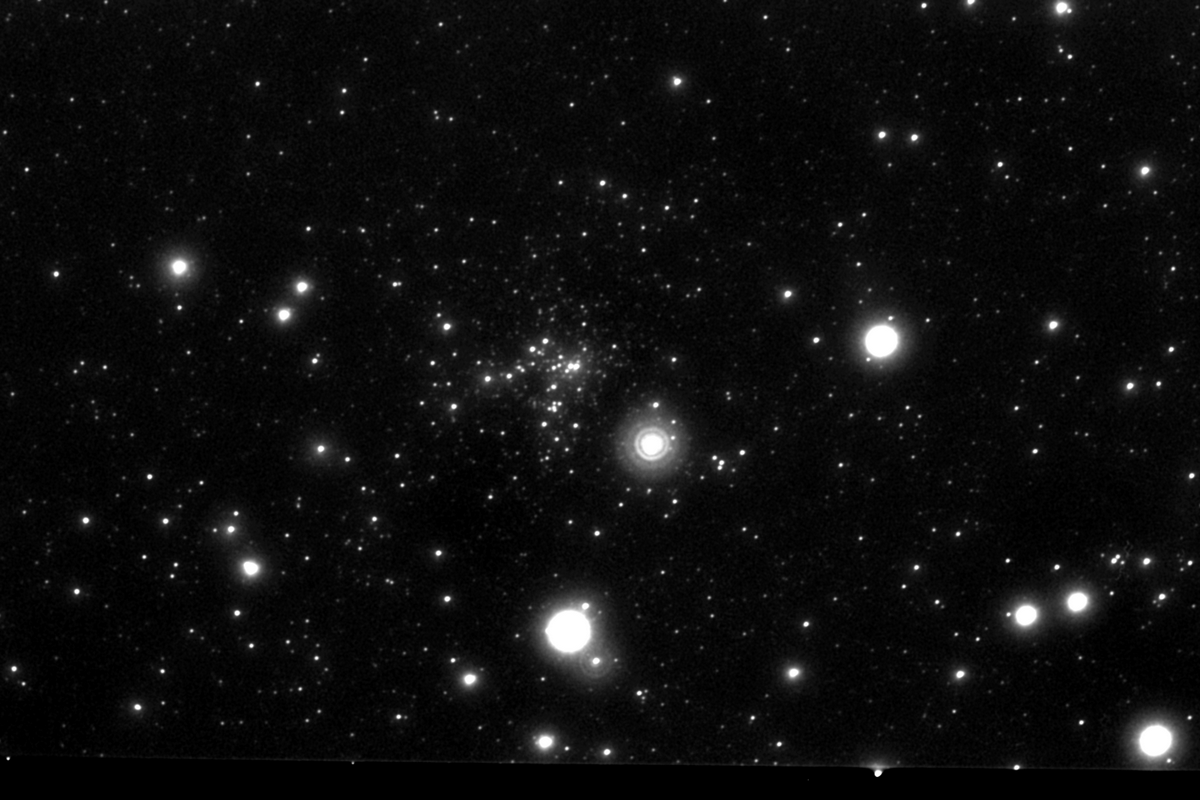
A billion-year-old cluster about 3,600 light years away where Kepler found the first planets seen to transit stars in a star cluster: two, both smaller than Neptune.
A hazy patch in 10x binoculars; best at around 70x in a moderate-aperture telescope; its brightest stars are only 10th magnitude, spread round what looks like a hole.
Best at 6:50 pm, 58° up in the north-west, setting. Not enough centres call it clear then. Above 25° from 6:50 pm to 10:15 pm (3.4 h) of the dark, with moonlight, which matters less for stars at its best.
Next good chance: not in the next month
Sent in by Marco Spiller. Stats for nerds Open cluster
Foxhead Cluster NGC 6819
An old star cluster, about 2.5 billion years old and 7,200 light years away, found by Caroline Herschel in 1784.
A telescope shows two dozen stars in a patch 5 arcminutes across.
Best at 6:50 pm, 58° up in the west, setting. Not enough centres call it clear then. Above 25° from 6:50 pm to 10:00 pm (3.2 h) of the dark, with moonlight, which matters less for stars at its best.
Next good chance: not in the next month
Open cluster
Frigate Bird Cluster NGC 6866
An open cluster in Cygnus aged at 430 million years, plus or minus 50 million, from the oscillations of its giant stars in Kepler data, half the age an isochrone fit gave it in 2015.
In an 8-inch Dobsonian, a couple of dozen fairly compact stars in an oblong group, with two almost parallel arcs of brighter stars at its centre like rounded chevrons.
Best at 6:50 pm, 62° up in the west, setting. Not enough centres call it clear then. Above 25° from 6:50 pm to 10:35 pm (3.8 h) of the dark, with moonlight, which matters less for stars at its best.
Next good chance: not in the next month
Open cluster
Crescent Nebula Cluster NGC 6883
A young cluster in Cygnus discovered by John Herschel in 1828; Gaia DR3 picks out 61 members at about 1,930 parsecs.
Dreyer's catalogue describes "a cluster, pretty rich, double star involved"; Seligman lists it as an 8th-magnitude cluster of Trumpler type I3p.
Best at 6:50 pm, 62° up in the west, setting. Not enough centres call it clear then. Above 25° from 6:50 pm to 10:15 pm (3.4 h) of the dark, with moonlight, which matters less for stars at its best.
Next good chance: not in the next month
Open cluster
Inchworm Cluster NGC 6910
A cluster 7 to 13 million years old, 3,710 light years away behind the Great Rift half a degree from Sadr, with four Beta Cephei variables, a high number for one cluster.
Visible in binoculars but too compact to resolve at low power; a 5-inch at low magnification shows a crescent between two brighter stars, and an 8-inch about 15 stars in a wavy Y.
Best at 6:50 pm, 65° up in the west, setting. Not enough centres call it clear then. Above 25° from 6:50 pm to 10:40 pm (3.8 h) of the dark, with moonlight, which matters less for stars at its best.
Next good chance: not in the next month
Open cluster
Flying Geese Cluster NGC 6939
A rich open cluster about 1.5 billion years old by a 2022 study, two-thirds of a degree from the spiral galaxy NGC 6946.
With 10x50 binoculars it and NGC 6946 appear as two patches of haze; a 4-inch telescope glimpses it and resolves it at 72x.
Best at 6:50 pm, 62° up in the north-west, setting. Not enough centres call it clear then. Above 25° from 6:50 pm to 12:15 am (5.4 h) of the dark, with moonlight, which matters less for stars at its best.
Next good chance: not in the next month
Open cluster
Mothra Cluster NGC 6940
An open cluster in Vulpecula with more than 20 red giants; spectra of 12 of them, with isochrone fits, give it an age of about 1.1 billion years and a near-solar metallicity.
Bright enough to be seen in small binoculars, which partly resolve it; Dreyer's catalogue calls it very bright, very large and very rich.
Best at 6:50 pm, 63° up in the west, setting. Not enough centres call it clear then. Above 25° from 6:50 pm to 10:15 pm (3.4 h) of the dark, with moonlight, which matters less for stars at its best.
Next good chance: not in the next month
Open cluster
NGC 6991
Where William and John Herschel each logged a different group of stars under one number; a 2019 Gaia study puts the loose cluster now catalogued as NGC 6991, centred away from both, at 573 parsecs and about a billion years old.
At William Herschel's position, a scattered group round a magnitude 5.7 star with the nebula IC 5076 on its west side; John Herschel's group, about 10 to 12 arcminutes south-west, barely stands out from the field.
Best at 6:50 pm, 71° up in the north-west, setting. Not enough centres call it clear then. Above 25° from 6:50 pm to 11:35 pm (4.8 h) of the dark, with moonlight, which matters less for stars at its best.
Next good chance: not in the next month
Globular cluster
NGC 7006
A halo globular about 40 kiloparsecs away whose orbit, by a 2001 proper-motion study, carries it out to about 102 kiloparsecs (plus or minus 28) from the centre of the Galaxy.
Magnitude 10.6 and about 3 arcminutes across; ESA calls it often ignored by amateur astronomers for its modest size, great distance and low brightness, and Dreyer's catalogue calls it bright, pretty large and round.
Best at 6:50 pm, 59° up in the south-west, setting. Not enough centres call it clear then. Above 25° from 6:50 pm to 10:05 pm (3.2 h) of the dark, with moonlight, which matters less for stars at its best.
Next good chance: not in the next month
Open cluster
Umbrella Cluster NGC 7063
A small, scattered cluster in Cygnus about 2,200 light years away, roughly 100 million years old, which a 1931 survey credited with 10 to 12 stars and Gaia gives 64 likely members.
A bright, scattered group about 10 arcminutes across, elongated north to south, with about ten stars of magnitude 9 to 10.5, a line of four at its west edge and a curving arc just east.
Best at 6:50 pm, 76° up in the west, setting. Not enough centres call it clear then. Above 25° from 6:50 pm to 11:30 pm (4.7 h) of the dark, with moonlight, which matters less for stars at its best.
Next good chance: not in the next month
Open cluster
Swimming Alligator Cluster NGC 7160
A cluster about 12 million years old where Spitzer found discs around 2 of its more than 60 low-mass stars, against about half the Sun-like stars in its 4-million-year-old neighbour Trumpler 37.
Dreyer's catalogue calls it "a cluster, poor, very little compressed"; Seligman counts half a dozen brighter and one or two dozen fainter stars over about 6 by 4 arcminutes.
Best at 6:50 pm, 67° up in the north, setting. Not enough centres call it clear then. Above 25° from 6:50 pm to 1:50 am (7 h) of the dark, with moonlight, which matters less for stars at its best.
Next good chance: not in the next month
Open cluster
NGC 7234
A cluster in Cepheus that the NGC lists twice: an error in reducing William Herschel's 1787 position made NGC 7234 look like a separate object from NGC 7235.
About two dozen stars of magnitude 9 to 15 in a 4 arcminute group elongated west-north-west to east-south-east, with a starless hole 1.5 arcminutes across beside a 9th magnitude star.
Best at 6:50 pm, 72° up in the north, setting. Not enough centres call it clear then. Above 25° from 6:50 pm to 1:40 am (6.8 h) of the dark, with moonlight, which matters less for stars at its best.
Next good chance: not in the next month
Open cluster
Dormouse Cluster NGC 7510
A young cluster in the Perseus spiral arm, about 2,900 to 3,500 parsecs away by two studies, whose stars William Herschel saw "arranged in lines" and his son called fan-shaped.
A wedge of stars: Steve Gottlieb counted about two dozen in a 13-inch at 62x, elongated south-west to north-east, and in a 17.5-inch a triangular group 5 by 2 arcminutes.
Best at 6:50 pm, 68° up in the north, rising. Not enough centres call it clear then. Above 25° from 6:50 pm to 2:55 am (8.1 h) of the dark, with moonlight, which matters less for stars at its best.
Next good chance: not in the next month
Open cluster
Caroline's Rose Cluster NGC 7789
Caroline Herschel's Rose: an open cluster in Cassiopeia about 7,600 light years away and about 1.5 billion years old, old enough that its brightest stars are red giants.
A rich cluster of 6.7 magnitude about 16 arcminutes across; seen visually, its loops of stars and dark lanes look like the petals of a rose seen from above.
Best at 6:50 pm, 68° up in the north-east, rising. Not enough centres call it clear then. Above 25° from 6:50 pm to 3:20 am (8.5 h) of the dark, with moonlight, which matters less for stars at its best.
Next good chance: not in the next month
What my 150 mm telescope and a small camera got from a back garden, 29 October 2026. M34 in the diary Open cluster
M34
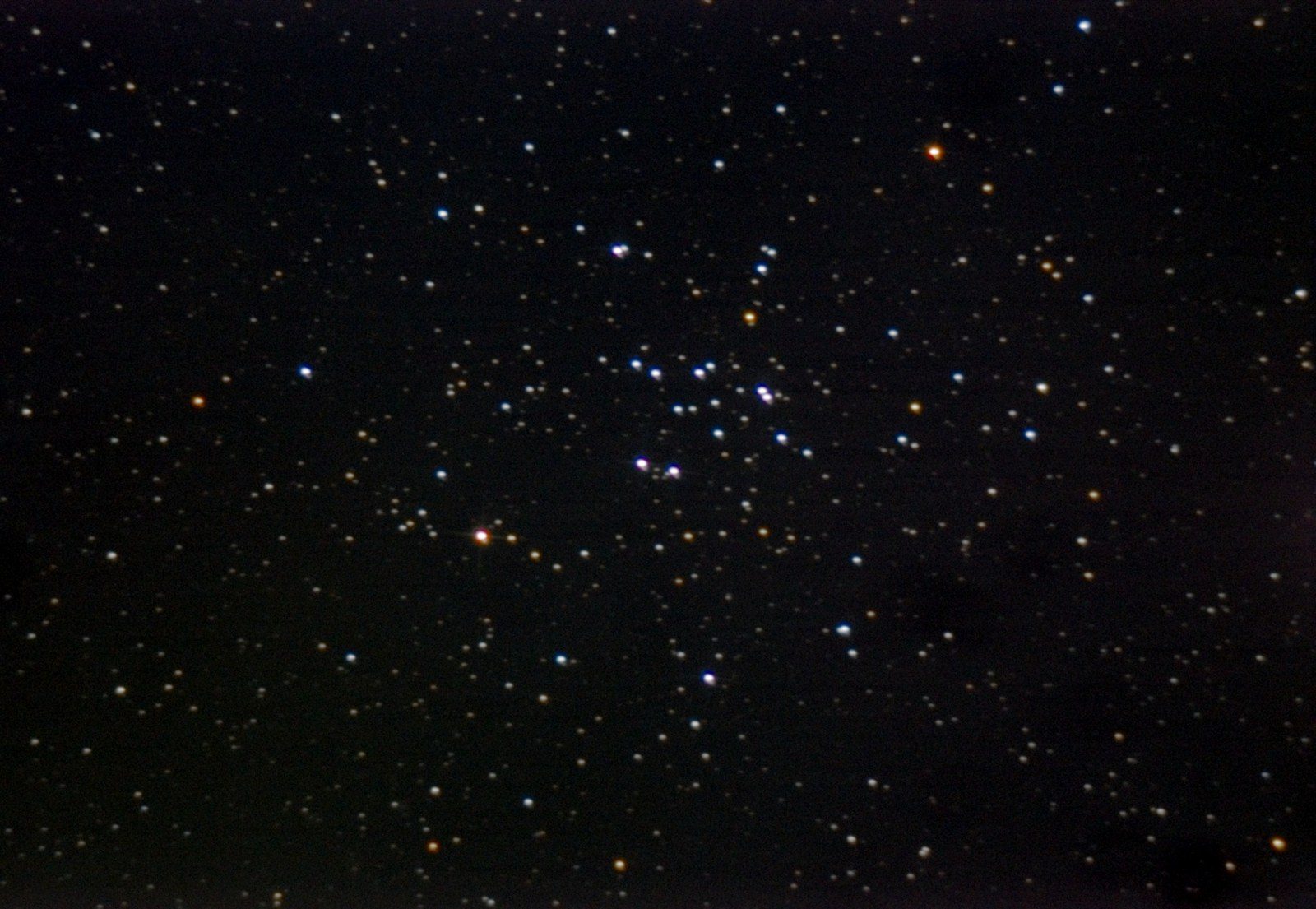
A cluster some 1,400 to 1,500 light years away whose stars' spin rates put its age at 240 million years, by a 2011 gyrochronology study.
A faint nebulous patch to the naked eye in good conditions, just north of the line from Algol to Gamma Andromedae; 10x50 binoculars resolve it, and larger amateur telescopes show about 80 stars.
Best at 7:25 pm, 50° up in the east, rising. Not enough centres call it clear then. Forecast clear and above 25° from 4:30 am to 5:05 am; moonlight matters less for stars. Above 25° from 6:50 pm to 5:05 am (10.2 h) of the dark, with moonlight, which matters less for stars at its best.
Next good chance: Fri 27 Nov, 6:45 pm to 8:30 pm. No clear spell for it in the forecast yet.
Open cluster
h Persei Cluster NGC 869
One half of the Double Cluster: hundreds of young stars 7,500 light years away, only about 14 million years old.
To the eye, a hazy patch beside its twin in Perseus; any optical aid splits the pair into two fields of stars.
Best at 7:25 pm, 55° up in the north-east, rising. Not enough centres call it clear then. Forecast clear and above 25° from 4:30 am to 5:30 am; moonlight matters less for stars. Above 25° from 6:50 pm to 5:45 am (10.9 h) of the dark, with moonlight, which matters less for stars at its best.
Next good chance: Fri 27 Nov, 6:45 pm to 8:30 pm. No clear spell for it in the forecast yet.
Open cluster
chi Persei Cluster NGC 884
One half of the Double Cluster: hundreds of young stars, about 14 million years old, 7,500 light years away.
The pair shows to the eye as one misty patch; any optical aid splits it into two clusters.
Best at 7:25 pm, 54° up in the north-east, rising. Not enough centres call it clear then. Forecast clear and above 25° from 4:30 am to 5:30 am; moonlight matters less for stars. Above 25° from 6:50 pm to 5:50 am (11 h) of the dark, with moonlight, which matters less for stars at its best.
Next good chance: Fri 27 Nov, 6:45 pm to 8:30 pm. No clear spell for it in the forecast yet.
Open cluster
Hyades C041
Hundreds of stars that share one age, about 625 million years, and one motion through space, their centre 151 to 153 light years away; Aldebaran, among them in the sky, is not a member.
A V of naked-eye stars round Aldebaran, the head of Taurus, 5.5 degrees across; the five brightest members are giants of magnitude 3.4 to 3.8.
Best at 3:30 am, 47° up in the west, setting. Not enough centres call it clear then. Forecast clear and above 25° from 4:30 am to 5:25 am; moonlight matters less for stars. Above 25° from 8:05 pm to 5:25 am (9.3 h) of the dark, with moonlight, which matters less for stars at its best.
Next good chance: not in the next month
Sent in by Lenny Kiersey. All 2 pictures Open cluster
Pleiades (M45)
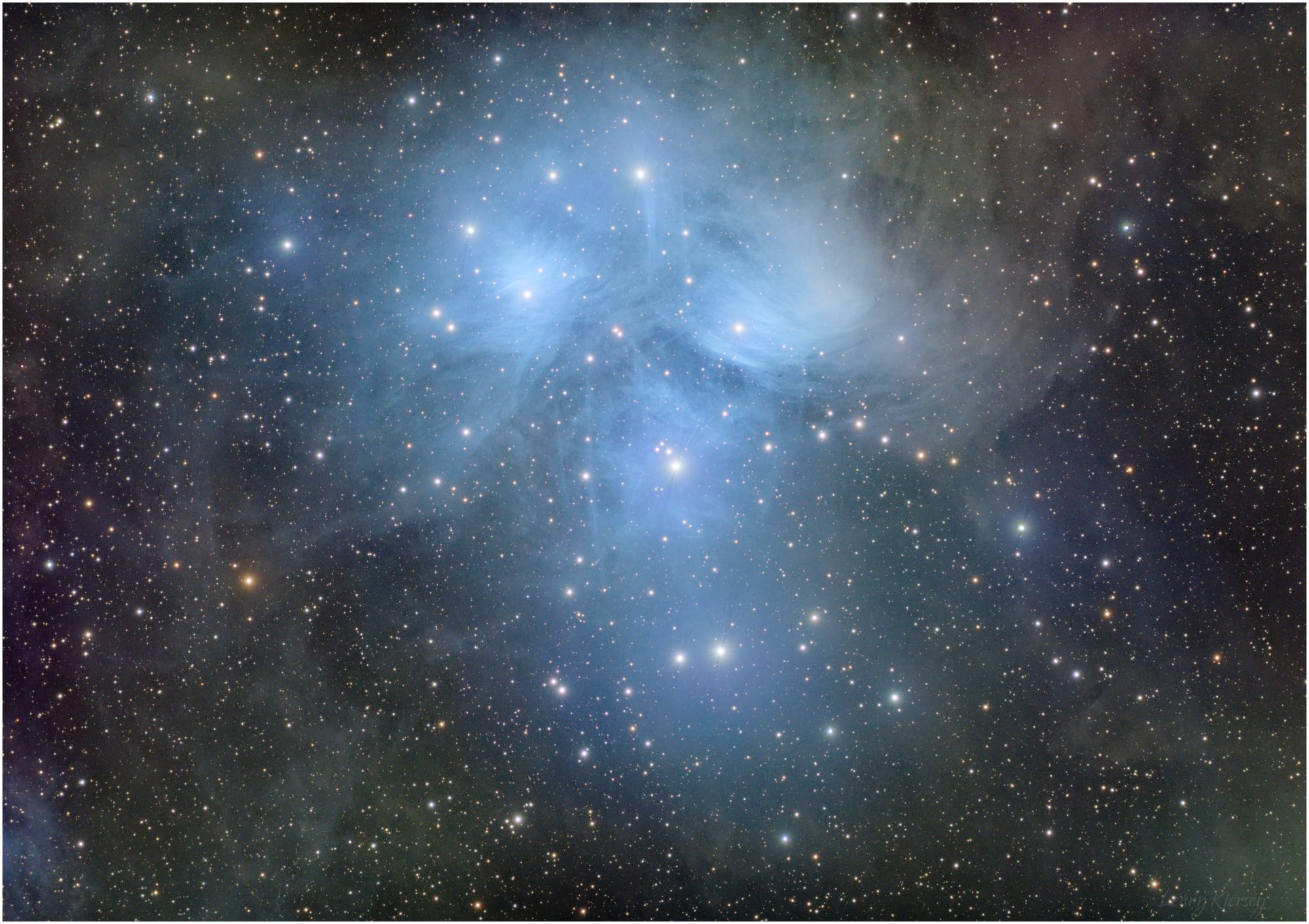
A family of young stars about 440 light years away, born together about 100 million years ago.
Six or seven stars to the eye; binoculars turn it into dozens.
Best at 3:30 am, 44° up in the west, setting. Not enough centres call it clear then. Forecast clear and above 25° from 4:30 am to 5:15 am; moonlight matters less for stars. Above 25° from 7:00 pm to 5:15 am (10.2 h) of the dark, with moonlight, which matters less for stars at its best.
Next good chance: Sat 28 Nov, 7:10 pm to 9:50 pm. No clear spell for it in the forecast yet.
Open cluster
Shoe-Buckle Cluster (M35)
A cluster of several hundred stars around 100 to 150 million years old, about 2,800 light years away.
A fuzzy spot to the eye on a very dark night; binoculars show a haze with some stars; a telescope shows a field of bright stars.
Best at 4:30 am, 60° up in the west, setting. Forecast clear then. Forecast clear and above 25° from 4:30 am to 5:30 am; moonlight matters less for stars. Above 25° from 9:20 pm to 5:55 am (8.6 h) of the dark, with moonlight, which matters less for stars at its best.
Next good chance: Sun 29 Nov, 9:30 pm to 11:05 pm. No clear spell for it in the forecast yet.
Open cluster
Pinwheel Cluster (M36)
A cluster of stars about 25 million years old, roughly 4,000 light years away, much like the Pleiades.
At the edge of naked-eye sight; binoculars show a small fuzzy patch with eight or ten stars; an 80 mm telescope shows about 15.
Best at 4:30 am, 58° up in the west, setting. Forecast clear then. Forecast clear and above 25° from 4:30 am to 5:30 am; moonlight matters less for stars. Above 25° from 8:20 pm to 5:55 am (9.6 h) of the dark, with moonlight, which matters less for stars at its best.
Next good chance: Sun 29 Nov, 8:30 pm to 11:05 pm. No clear spell for it in the forecast yet.
What my 150 mm telescope and a small camera got from a back garden, 18 October 2026. M37 in the diary Open cluster
Salt and Pepper Cluster (M37)
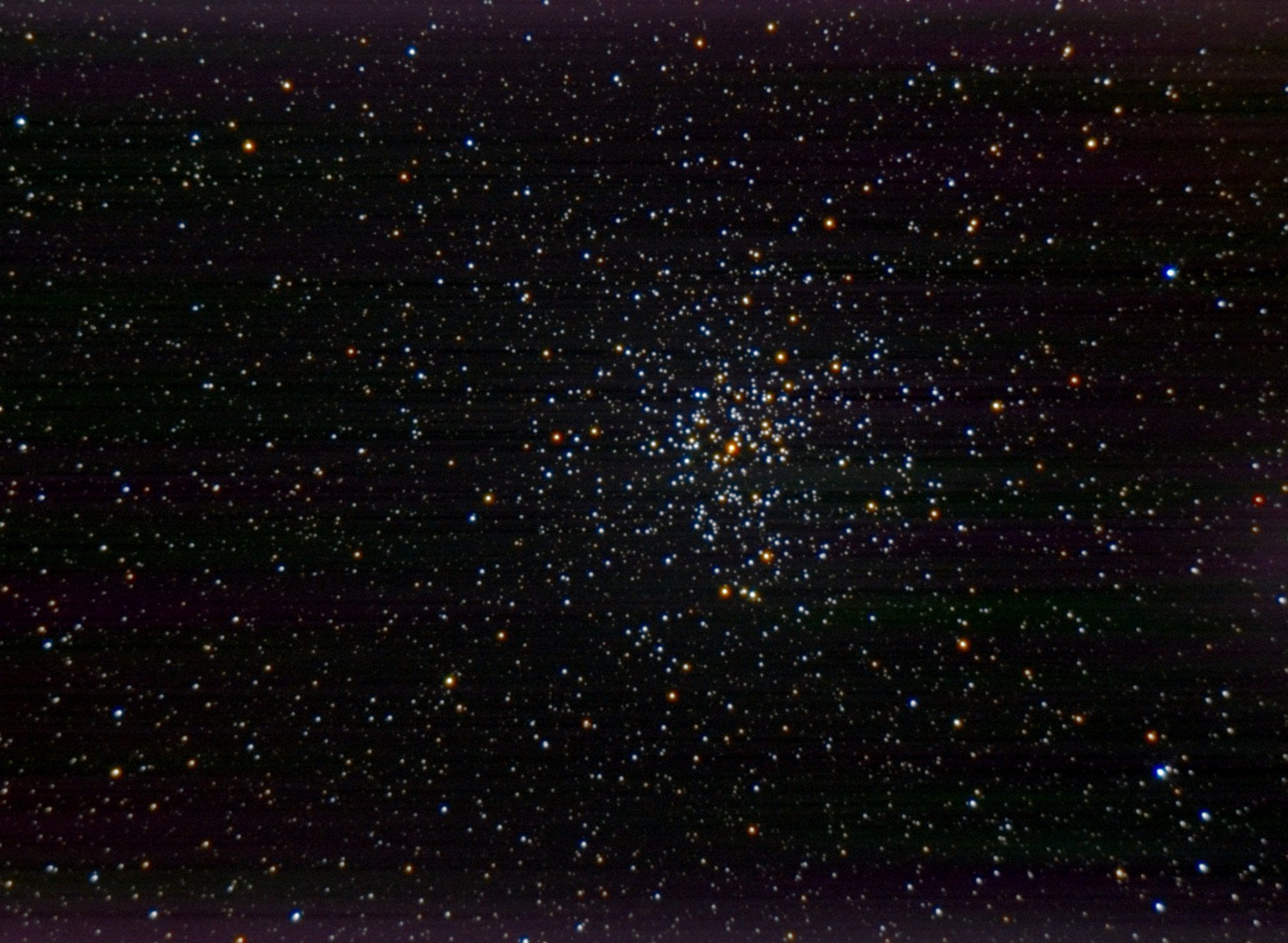
The richest cluster in Auriga: about 150 bright stars in a patch nearly a full Moon wide, 4,500 light years away.
Just visible to the eye in a dark sky; a misty patch in binoculars; a 6-inch telescope shows 25 to 40 stars.
Best at 4:30 am, 61° up in the west, setting. Forecast clear then. Forecast clear and above 25° from 4:30 am to 5:30 am; moonlight matters less for stars. Above 25° from 8:40 pm to 5:55 am (9.2 h) of the dark, with moonlight, which matters less for stars at its best.
Next good chance: Sun 29 Nov, 8:50 pm to 11:05 pm. No clear spell for it in the forecast yet.
Open cluster
Starfish Cluster (M38)
An open cluster of about 100 stars, a few hundred million years old, sharing its patch of sky with NGC 1907, a cluster that simulations suggest was born elsewhere in the Galaxy and is passing by.
Binoculars show it in Auriga, 2.5 degrees north-west of M36; its brightest stars make a pattern like the Greek letter Pi, or Webb's "oblique cross", which Walter Scott Houston wrote "seems more pronounced with small instruments".
Best at 4:30 am, 58° up in the west, setting. Forecast clear then. Forecast clear and above 25° from 4:30 am to 5:30 am; moonlight matters less for stars. Above 25° from 8:05 pm to 5:55 am (9.8 h) of the dark, with moonlight, which matters less for stars at its best.
Next good chance: Sat 28 Nov, 8:20 pm to 9:50 pm. No clear spell for it in the forecast yet.
Open cluster
M46
A cluster of about 500 stars some 5,000 light years away, with a planetary nebula, NGC 2438, on its northern edge that radial velocities put about 30 km/s apart from the cluster, ruling out current membership.
Messier needed a good refractor to see its stars and noted a bit of nebulosity; it sits about a degree east of M47, so the two share a binocular field.
Best at 4:30 am, 35° up in the south, setting. Forecast clear then. Forecast clear and above 25° from 4:30 am to 5:30 am; moonlight matters less for stars. Above 25° from 1:30 am to 5:55 am (4.4 h) of the dark, with moonlight, which matters less for stars at its best.
Next good chance: Wed 2 Dec, 1:45 am to 5:15 am. Beyond the forecast.
Open cluster
M47
One of Messier's missing objects until 1959, because he got a sign wrong when working out its position; that year T. F. Morris matched it to NGC 2422, 1,600 light years away.
A coarse cluster of bright stars about 30 arcminutes across, which can be glimpsed with the naked eye under good conditions as a dim patch.
Best at 4:30 am, 35° up in the south, setting. Forecast clear then. Forecast clear and above 25° from 4:30 am to 5:30 am; moonlight matters less for stars. Above 25° from 1:25 am to 5:55 am (4.5 h) of the dark, with moonlight, which matters less for stars at its best.
Next good chance: Wed 2 Dec, 1:35 am to 5:10 am. Beyond the forecast.
Open cluster
Heart-shaped Cluster (M50)
Studied for over a century as one cluster, until a 2024 Gaia study split its stars into two groups whose motions across the sky differ by 2.2 km/s, both 158 million years old, which its simulations suggest formed together and orbit each other, about 2,900 light years away.
A heart-shaped or arrowhead-shaped group about 16 arcminutes across, with a red giant 7 arcminutes south of centre standing out among blue-white stars.
Best at 4:30 am, 39° up in the south-west, setting. Forecast clear then. Forecast clear and above 25° from 4:30 am to 5:30 am; moonlight matters less for stars. Above 25° from 12:15 am to 5:55 am (5.7 h) of the dark, with moonlight, which matters less for stars at its best.
Next good chance: Tue 1 Dec, 12:20 am to 3:40 am. Beyond the forecast.
Open cluster
Stingray Cluster NGC 1342
Found by William Herschel on 28 December 1799, about 2,170 light years away by WEBDA's figure, and called the Little Scorpion because its stars look like a small copy of Scorpius.
At magnitude 6.7 it is marginally visible to the naked eye; John Herschel, with a 20-foot reflector, described a cluster of about 60 stars that filled the field of view.
Best at 4:30 am, 36° up in the west, setting. Forecast clear then. Forecast clear and above 25° from 4:30 am to 5:30 am; moonlight matters less for stars. Above 25° from 6:50 pm to 5:40 am (10.8 h) of the dark, with moonlight, which matters less for stars at its best.
Next good chance: not in the next month
Open cluster
Jolly Roger Cluster NGC 1502
A cluster about 1,100 parsecs away and perhaps 5 million years old, where Kemble's Cascade ends, with the quadruple star system SZ Camelopardalis in the bright pair at its centre.
Magnitude 6.0 to 6.9 by different sources, which Wikipedia calls dimly visible to the eye; Kemble's Cascade, a 3-degree line of more than 20 stars, runs down into it from the north-west.
Best at 4:30 am, 48° up in the north-west, setting. Forecast clear then. Forecast clear and above 25° from 4:30 am to 5:30 am; moonlight matters less for stars. Above 25° from 6:50 pm to 5:55 am (11.1 h) of the dark, with moonlight, which matters less for stars at its best.
Next good chance: not in the next month
Open cluster
NGC 1528
A Perseus cluster about 110 million years old and 954 ± 154 parsecs (about 3,100 light years) away, by a 2019 photometric study of 65 stars in its direction.
Clearly visible in 10x50 binoculars, about 18 arcminutes across; Dreyer's catalogue calls it 'a cluster, bright, very rich, considerably compressed'.
Best at 4:30 am, 48° up in the north-west, setting. Forecast clear then. Forecast clear and above 25° from 4:30 am to 5:30 am; moonlight matters less for stars. Above 25° from 6:50 pm to 5:55 am (11.1 h) of the dark, with moonlight, which matters less for stars at its best.
Next good chance: not in the next month
Open cluster
Pirate Moon Cluster NGC 1647
A cluster seen through the Taurus dark clouds, about 200 million years old by its stars' lithium, whose smeared main sequence a 2026 study traced mainly to dust dimming some members more than others.
Visible in binoculars near Aldebaran; a 13-inch shows about 80 scattered stars, including a matched pair of magnitude 8.5 and 8.9, 33 arcseconds apart, at the centre.
Best at 4:30 am, 41° up in the west, setting. Forecast clear then. Forecast clear and above 25° from 4:30 am to 5:30 am; moonlight matters less for stars. Above 25° from 8:15 pm to 5:55 am (9.7 h) of the dark, with moonlight, which matters less for stars at its best.
Next good chance: not in the next month
Open cluster
NGC 1662
A scattered cluster in Orion, 428 parsecs (about 1,400 light years) away in a 2020 Gaia catalogue, whose brighter stars Steve Gottlieb saw as a boat with a mast.
Herschel saw its stars in the finder; in a 17.5-inch Gottlieb counted about 40 stars within 15 arcminutes, the brighter ones in a boat shape with the quadruple star HJ 684 as its mast.
Best at 4:30 am, 36° up in the west, setting. Forecast clear then. Forecast clear and above 25° from 4:30 am to 5:30 am; moonlight matters less for stars. Above 25° from 8:45 pm to 5:35 am (8.8 h) of the dark, with moonlight, which matters less for stars at its best.
Next good chance: not in the next month
Open cluster
Kite Cluster NGC 1664
An open cluster in Auriga about 1,289 parsecs away and 675 million years old by a 2022 study, whose published ages have ranged from 90 to 675 million years.
Steve Gottlieb counted 40 to 45 stars in a 13-inch, with many faint doubles and chains and a long string of stars leading south to a magnitude 7.5 star.
Best at 4:30 am, 53° up in the north-west, setting. Forecast clear then. Forecast clear and above 25° from 4:30 am to 5:30 am; moonlight matters less for stars. Above 25° from 7:05 pm to 5:55 am (10.8 h) of the dark, with moonlight, which matters less for stars at its best.
Next good chance: not in the next month
Open cluster
Poor Man's Double Cluster NGC 1807
A group of bright stars 25 arcminutes from NGC 1817 whose status is disputed: a 2004 study found no photometric or astrometric evidence that it is a real cluster, while a 2013 infrared study fitted it as a cluster 3 million years old.
Steve Gottlieb counted about 30 stars of magnitude 9 to 14 in 12 arcminutes in a 17.5-inch, with five bright ones in a north-south string, and NGC 1817 lies 25 arcminutes to the north-east.
Best at 4:30 am, 44° up in the west, setting. Forecast clear then. Forecast clear and above 25° from 4:30 am to 5:30 am; moonlight matters less for stars. Above 25° from 8:45 pm to 5:55 am (9.2 h) of the dark, with moonlight, which matters less for stars at its best.
Next good chance: not in the next month
Open cluster
Poor Man's Double Cluster NGC 1817
An open cluster 0.8 to 1.2 billion years old, about the Hyades' age, with at least 16 Delta Scuti pulsating stars found in its field by a 2009 survey.
A 7.7-magnitude cluster 20 arcminutes across, 25 arcminutes north-east of NGC 1807; Magda Streicher found it fainter than its neighbour but larger and more concentrated, with a chain of stars running north to south through it.
Best at 4:30 am, 44° up in the west, setting. Forecast clear then. Forecast clear and above 25° from 4:30 am to 5:30 am; moonlight matters less for stars. Above 25° from 8:50 pm to 5:55 am (9.1 h) of the dark, with moonlight, which matters less for stars at its best.
Next good chance: not in the next month
Open cluster
NGC 2129
A 1994 star count concluded there was no cluster here at all; in 2006 CCD photometry picked out 37 likely members and put it at 2,200 parsecs and about 10 million years old.
Steve Gottlieb, with a 17.5-inch, saw about three dozen stars of magnitude 10 to 14 in a 5 arcminute, well-detached group around two stars of magnitude 7.5 and 8 lying north and south of each other.
Best at 4:30 am, 58° up in the west, setting. Forecast clear then. Forecast clear and above 25° from 4:30 am to 5:30 am; moonlight matters less for stars. Above 25° from 9:15 pm to 5:55 am (8.7 h) of the dark, with moonlight, which matters less for stars at its best.
Next good chance: not in the next month
Open cluster
"37" NGC 2169
Its brighter stars happen to spell out the number 37, and the cluster is about 11 million years old by a 2013 estimate.
A small group about 6 to 7 arcminutes across, 5.9 magnitude in total; in a telescope the brighter stars form a "3" and a "7" side by side.
Best at 4:30 am, 52° up in the south-west, setting. Forecast clear then. Forecast clear and above 25° from 4:30 am to 5:30 am; moonlight matters less for stars. Above 25° from 9:55 pm to 5:55 am (8 h) of the dark, with moonlight, which matters less for stars at its best.
Next good chance: Mon 30 Nov, 9:55 pm to 1:25 am. No clear spell for it in the forecast yet.
Open cluster
Broken Heart Cluster NGC 2281
An Auriga cluster about 528 parsecs away and 630 to 661 million years old by a 2021 study, which William Herschel had already seen in 1782, six years before he catalogued it.
Magnitude 5.4, spread over 18 to 25 arcminutes; Dreyer's catalogue calls it a pretty rich cluster of pretty large stars, very little compressed.
Best at 4:30 am, 74° up in the west, setting. Forecast clear then. Forecast clear and above 25° from 4:30 am to 5:30 am; moonlight matters less for stars. Above 25° from 9:10 pm to 5:55 am (8.8 h) of the dark, with moonlight, which matters less for stars at its best.
Next good chance: Sun 29 Nov, 9:20 pm to 11:05 pm. No clear spell for it in the forecast yet.
Open cluster
Great Bird Cluster NGC 2301
One of the clusters in a Chandra study, released in 2026, in which Sun-like stars older than about 100 million years gave out a quarter to a third of the X-rays the researchers expected.
Visible in 7x50 binoculars, about 12 arcminutes across; its brightest star, an orange subgiant of magnitude 8.0, may be a foreground star rather than a member.
Best at 4:30 am, 46° up in the south-west, setting. Forecast clear then. Forecast clear and above 25° from 4:30 am to 5:30 am; moonlight matters less for stars. Above 25° from 11:25 pm to 5:55 am (6.5 h) of the dark, with moonlight, which matters less for stars at its best.
Next good chance: Tue 1 Dec, 11:25 pm to 4:30 am. Beyond the forecast.
Open cluster
Caroline's Cluster NGC 2360
The cluster Caroline Herschel found on 26 February 1783, before her brother began his sweeps for nebulae; estimates of its age run from under 1 billion to 2.2 billion years.
A rich cluster of 7.2 magnitude about 13 to 14 arcminutes across, its stars of fairly even 11th to 12th magnitude, with an unrelated 5.5 magnitude star by its western edge.
Best at 4:30 am, 33° up in the south, setting. Forecast clear then. Forecast clear and above 25° from 4:30 am to 5:30 am; moonlight matters less for stars. Above 25° from 1:15 am to 5:55 am (4.7 h) of the dark, with moonlight, which matters less for stars at its best.
Next good chance: not in the next month
Open cluster
Twinkling Comet Cluster NGC 2420
About 1,000 stars, 1.7 to 2 billion years old, with roughly the Sun's composition, yet sitting about 3,000 light years above the Milky Way's disc where clusters like it are rarely found.
In a small telescope at low power a uniform ghostly glow brightening to the centre, like a comet without a tail; at x33 a few stars show with averted vision, and higher power resolves a rich field.
Best at 4:30 am, 70° up in the south-west, setting. Forecast clear then. Forecast clear and above 25° from 4:30 am to 5:30 am; moonlight matters less for stars. Above 25° from 11:00 pm to 5:55 am (6.9 h) of the dark, with moonlight, which matters less for stars at its best.
Next good chance: not in the next month
Open cluster
Trapezium Asterism Trapezium
Best at 4:30 am, 32° up in the south-west, setting. Forecast clear then. Forecast clear and above 25° from 4:30 am to 5:15 am; moonlight matters less for stars. Above 25° from 10:30 pm to 5:15 am (6.8 h) of the dark, with moonlight, which matters less for stars at its best.
Next good chance: not in the next month
Globular cluster
Intergalactic Wanderer Cluster NGC 2419
The Intergalactic Wanderer: a globular cluster about 290,000 light years away, nearly twice as far as the Large Magellanic Cloud, and the most remote Milky Way object visible in moderate amateur telescopes.
Magnitude 10.4 and 4 arcminutes across, within reach of medium-sized amateur telescopes despite its distance; it is on the RASC's Deep Sky Challenge list.
Best at 4:50 am, 79° up in the west, setting. Forecast clear then. Forecast clear and above 25° from 4:30 am to 5:30 am; moonlight matters less for stars. Above 25° from 10:05 pm to 5:55 am (7.8 h) of the dark, with moonlight, which matters less for stars at its best.
Next good chance: not in the next month
Open cluster
Dish Cluster NGC 2539
The Dish Cluster: about 455 probable members spread over 15 arcminutes, 4,400 light years away and 370 to 630 million years old, with a 4.7-magnitude foreground star at its edge.
Magnitude 6.5 and 15 arcminutes across; Dreyer's catalogue calls it very large and rich, a little compressed, with stars from 11th to 13th magnitude, and 19 Puppis sits at the edge.
Best at 4:55 am, 37° up in the south, setting. Forecast clear then. Forecast clear and above 25° from 4:30 am to 5:30 am; moonlight matters less for stars. Above 25° from 1:45 am to 5:55 am (4.2 h) of the dark, with moonlight, which matters less for stars at its best.
Next good chance: not in the next month
Open cluster
M48
A cluster that Messier logged 5 degrees out of place in 1771, lost for over 160 years, and since found to be split into three clumps each drifting its own way, 2,500 light years off.
Visible to the naked eye under good skies; binoculars or a small telescope show about 50 stars brighter than magnitude 13 across a core 30 arcminutes wide, the size of the full Moon.
Best at 5:05 am, 43° up in the south, setting. Forecast clear then. Forecast clear and above 25° from 4:30 am to 5:30 am; moonlight matters less for stars. Above 25° from 1:10 am to 5:55 am (4.8 h) of the dark, with moonlight, which matters less for stars at its best.
Next good chance: Wed 2 Dec, 1:15 am to 6:05 am. Beyond the forecast.
Double star
M40
Not a nebula or even a true double: two unrelated stars, one about 1,000 light years away and the other about 470, that Messier logged in 1764 while hunting a nebula that was never there.
Two stars of magnitude 9.6 and 10.1, about 52 arcseconds apart, 16 arcminutes north-east of 70 Ursae Majoris.
Best at 5:25 am, 55° up in the north-east, rising. Forecast clear then. Forecast clear and above 25° from 4:30 am to 5:30 am; moonlight matters less for stars. Above 25° from 1:30 am to 5:55 am (4.4 h) of the dark, with moonlight, which matters less for stars at its best.
Next good chance: Wed 2 Dec, 1:45 am to 6:05 am. Beyond the forecast.
Open cluster
Beehive (M44)
About 1,000 stars 600 light years away, 600 to 700 million years old.
A blur of light to the eye; binoculars show about 20 stars; a telescope shows hundreds.
Best at 5:25 am, 69° up in the south, setting. Forecast clear then. Forecast clear and above 25° from 4:30 am to 5:30 am; moonlight matters less for stars. Above 25° from 12:05 am to 5:55 am (5.8 h) of the dark, with moonlight, which matters less for stars at its best.
Next good chance: Tue 1 Dec, 12:05 am to 2:50 am. Beyond the forecast.
Open cluster
King Cobra Cluster (M67)
About 4 billion years old, close to the Sun's age, it is the oldest open cluster in Messier's catalogue and holds more than 100 Sun-like stars.
A faint patch in binoculars; telescopes resolve from a few up to about 100 of its stars.
Best at 5:25 am, 61° up in the south, setting. Forecast clear then. Forecast clear and above 25° from 4:30 am to 5:30 am; moonlight matters less for stars. Above 25° from 12:40 am to 5:55 am (5.2 h) of the dark, with moonlight, which matters less for stars at its best.
Next good chance: Wed 2 Dec, 12:35 am to 6:05 am. Beyond the forecast.
Open cluster
Coma Star Cluster (Mel111)
The scattered cluster that forms Berenice's hair, about 85 parsecs (280 light years) away, with a leading and a trailing tidal tail each some 50 parsecs long found in Gaia data in 2019.
Large and conspicuous to the eye, SEDS says, at total magnitude 1.8 and about 4.5 degrees across; its brighter stars make a V shape as Coma Berenices rises.
Best at 5:25 am, 47° up in the east, rising. Forecast clear then. Forecast clear and above 25° from 4:30 am to 5:30 am; moonlight matters less for stars. Above 25° from 3:30 am to 5:55 am (2.4 h) of the dark, with moonlight, which matters less for stars at its best.
Next good chance: not in the next month
The same list as a table
| Object | Best | Where | Above 25° in the dark | Next good chance |
|---|---|---|---|---|
| M103 · open cluster | 6:50 pm | 55° north-east | 6:50 pm to 5:20 am (10.5 h) | Fri 27 Nov, 6:45 pm to 8:30 pmno clear spell for it in the forecast yet |
| Great Pegasus Cluster (M15) · globular | 6:50 pm | 59° south-west | 6:50 pm to 10:20 pm (3.5 h) | Fri 27 Nov, 6:45 pm to 8:30 pmno clear spell for it in the forecast yet |
| M2 · globular | 6:50 pm | 47° south | 6:50 pm to 9:35 pm (2.8 h) | Fri 27 Nov, 6:45 pm to 8:30 pmno clear spell for it in the forecast yet |
| Cooling Tower Cluster (M29) · open cluster | 6:50 pm | 65° west | 6:50 pm to 10:35 pm (3.8 h) | Fri 27 Nov, 6:45 pm to 8:30 pmno clear spell for it in the forecast yet |
| M39 · open cluster | 6:50 pm | 76° north-west | 6:50 pm to 12:15 am (5.4 h) | Fri 27 Nov, 6:45 pm to 8:30 pmno clear spell for it in the forecast yet |
| Scorpion Cluster (M52) · open cluster | 6:50 pm | 67° north | 6:50 pm to 3:15 am (8.4 h) | Fri 27 Nov, 6:45 pm to 8:30 pmno clear spell for it in the forecast yet |
| M56 · globular | 6:50 pm | 49° west | 6:50 pm to 9:00 pm (2.2 h) | Fri 27 Nov, 6:45 pm to 8:20 pmno clear spell for it in the forecast yet |
| Angelfish Cluster (M71) · globular | 6:50 pm | 50° west | 6:50 pm to 9:05 pm (2.2 h) | Fri 27 Nov, 6:45 pm to 8:25 pmno clear spell for it in the forecast yet |
| Sailboat Cluster NGC 225 · open cluster | 6:50 pm | 60° north-east | 6:50 pm to 4:35 am (9.8 h) | not in the next month |
| Owl Cluster NGC 457 · open cluster | 6:50 pm | 58° north-east | 6:50 pm to 4:50 am (10 h) | not in the next month |
| NGC 559 · open cluster | 6:50 pm | 55° north-east | 6:50 pm to 5:35 am (10.8 h) | not in the next month |
| NGC 654 · open cluster | 6:50 pm | 54° north-east | 6:50 pm to 5:40 am (10.8 h) | not in the next month |
| Hole in a Cluster NGC 6811 · open cluster | 6:50 pm | 58° north-west | 6:50 pm to 10:15 pm (3.4 h) | not in the next month |
| Foxhead Cluster NGC 6819 · open cluster | 6:50 pm | 58° west | 6:50 pm to 10:00 pm (3.2 h) | not in the next month |
| Frigate Bird Cluster NGC 6866 · open cluster | 6:50 pm | 62° west | 6:50 pm to 10:35 pm (3.8 h) | not in the next month |
| Crescent Nebula Cluster NGC 6883 · open cluster | 6:50 pm | 62° west | 6:50 pm to 10:15 pm (3.4 h) | not in the next month |
| Inchworm Cluster NGC 6910 · open cluster | 6:50 pm | 65° west | 6:50 pm to 10:40 pm (3.8 h) | not in the next month |
| Flying Geese Cluster NGC 6939 · open cluster | 6:50 pm | 62° north-west | 6:50 pm to 12:15 am (5.4 h) | not in the next month |
| Mothra Cluster NGC 6940 · open cluster | 6:50 pm | 63° west | 6:50 pm to 10:15 pm (3.4 h) | not in the next month |
| NGC 6991 · open cluster | 6:50 pm | 71° north-west | 6:50 pm to 11:35 pm (4.8 h) | not in the next month |
| NGC 7006 · globular | 6:50 pm | 59° south-west | 6:50 pm to 10:05 pm (3.2 h) | not in the next month |
| Umbrella Cluster NGC 7063 · open cluster | 6:50 pm | 76° west | 6:50 pm to 11:30 pm (4.7 h) | not in the next month |
| Swimming Alligator Cluster NGC 7160 · open cluster | 6:50 pm | 67° north | 6:50 pm to 1:50 am (7 h) | not in the next month |
| NGC 7234 · open cluster | 6:50 pm | 72° north | 6:50 pm to 1:40 am (6.8 h) | not in the next month |
| Dormouse Cluster NGC 7510 · open cluster | 6:50 pm | 68° north | 6:50 pm to 2:55 am (8.1 h) | not in the next month |
| Caroline's Rose Cluster NGC 7789 · open cluster | 6:50 pm | 68° north-east | 6:50 pm to 3:20 am (8.5 h) | not in the next month |
| M34 · open cluster | 7:25 pm | 50° east | 6:50 pm to 5:05 am (10.2 h) | Fri 27 Nov, 6:45 pm to 8:30 pmno clear spell for it in the forecast yet |
| h Persei Cluster NGC 869 · open cluster | 7:25 pm | 55° north-east | 6:50 pm to 5:45 am (10.9 h) | Fri 27 Nov, 6:45 pm to 8:30 pmno clear spell for it in the forecast yet |
| chi Persei Cluster NGC 884 · open cluster | 7:25 pm | 54° north-east | 6:50 pm to 5:50 am (11 h) | Fri 27 Nov, 6:45 pm to 8:30 pmno clear spell for it in the forecast yet |
| Hyades C041 · open cluster | 3:30 am | 47° west | 8:05 pm to 5:25 am (9.3 h) | not in the next month |
| Pleiades (M45) · open cluster | 3:30 am | 44° west | 7:00 pm to 5:15 am (10.2 h) | Sat 28 Nov, 7:10 pm to 9:50 pmno clear spell for it in the forecast yet |
| Shoe-Buckle Cluster (M35) · open cluster | 4:30 am | 60° west | 9:20 pm to 5:55 am (8.6 h) | Sun 29 Nov, 9:30 pm to 11:05 pmno clear spell for it in the forecast yet |
| Pinwheel Cluster (M36) · open cluster | 4:30 am | 58° west | 8:20 pm to 5:55 am (9.6 h) | Sun 29 Nov, 8:30 pm to 11:05 pmno clear spell for it in the forecast yet |
| Salt and Pepper Cluster (M37) · open cluster | 4:30 am | 61° west | 8:40 pm to 5:55 am (9.2 h) | Sun 29 Nov, 8:50 pm to 11:05 pmno clear spell for it in the forecast yet |
| Starfish Cluster (M38) · open cluster | 4:30 am | 58° west | 8:05 pm to 5:55 am (9.8 h) | Sat 28 Nov, 8:20 pm to 9:50 pmno clear spell for it in the forecast yet |
| M46 · open cluster | 4:30 am | 35° south | 1:30 am to 5:55 am (4.4 h) | Wed 2 Dec, 1:45 am to 5:15 ambeyond the forecast |
| M47 · open cluster | 4:30 am | 35° south | 1:25 am to 5:55 am (4.5 h) | Wed 2 Dec, 1:35 am to 5:10 ambeyond the forecast |
| Heart-shaped Cluster (M50) · open cluster | 4:30 am | 39° south-west | 12:15 am to 5:55 am (5.7 h) | Tue 1 Dec, 12:20 am to 3:40 ambeyond the forecast |
| Stingray Cluster NGC 1342 · open cluster | 4:30 am | 36° west | 6:50 pm to 5:40 am (10.8 h) | not in the next month |
| Jolly Roger Cluster NGC 1502 · open cluster | 4:30 am | 48° north-west | 6:50 pm to 5:55 am (11.1 h) | not in the next month |
| NGC 1528 · open cluster | 4:30 am | 48° north-west | 6:50 pm to 5:55 am (11.1 h) | not in the next month |
| Pirate Moon Cluster NGC 1647 · open cluster | 4:30 am | 41° west | 8:15 pm to 5:55 am (9.7 h) | not in the next month |
| NGC 1662 · open cluster | 4:30 am | 36° west | 8:45 pm to 5:35 am (8.8 h) | not in the next month |
| Kite Cluster NGC 1664 · open cluster | 4:30 am | 53° north-west | 7:05 pm to 5:55 am (10.8 h) | not in the next month |
| Poor Man's Double Cluster NGC 1807 · open cluster | 4:30 am | 44° west | 8:45 pm to 5:55 am (9.2 h) | not in the next month |
| Poor Man's Double Cluster NGC 1817 · open cluster | 4:30 am | 44° west | 8:50 pm to 5:55 am (9.1 h) | not in the next month |
| NGC 2129 · open cluster | 4:30 am | 58° west | 9:15 pm to 5:55 am (8.7 h) | not in the next month |
| "37" NGC 2169 · open cluster | 4:30 am | 52° south-west | 9:55 pm to 5:55 am (8 h) | Mon 30 Nov, 9:55 pm to 1:25 amno clear spell for it in the forecast yet |
| Broken Heart Cluster NGC 2281 · open cluster | 4:30 am | 74° west | 9:10 pm to 5:55 am (8.8 h) | Sun 29 Nov, 9:20 pm to 11:05 pmno clear spell for it in the forecast yet |
| Great Bird Cluster NGC 2301 · open cluster | 4:30 am | 46° south-west | 11:25 pm to 5:55 am (6.5 h) | Tue 1 Dec, 11:25 pm to 4:30 ambeyond the forecast |
| Caroline's Cluster NGC 2360 · open cluster | 4:30 am | 33° south | 1:15 am to 5:55 am (4.7 h) | not in the next month |
| Twinkling Comet Cluster NGC 2420 · open cluster | 4:30 am | 70° south-west | 11:00 pm to 5:55 am (6.9 h) | not in the next month |
| Trapezium Asterism Trapezium · open cluster | 4:30 am | 32° south-west | 10:30 pm to 5:15 am (6.8 h) | not in the next month |
| Intergalactic Wanderer Cluster NGC 2419 · globular | 4:50 am | 79° west | 10:05 pm to 5:55 am (7.8 h) | not in the next month |
| Dish Cluster NGC 2539 · open cluster | 4:55 am | 37° south | 1:45 am to 5:55 am (4.2 h) | not in the next month |
| M48 · open cluster | 5:05 am | 43° south | 1:10 am to 5:55 am (4.8 h) | Wed 2 Dec, 1:15 am to 6:05 ambeyond the forecast |
| M40 · double star | 5:25 am | 55° north-east | 1:30 am to 5:55 am (4.4 h) | Wed 2 Dec, 1:45 am to 6:05 ambeyond the forecast |
| Beehive (M44) · open cluster | 5:25 am | 69° south | 12:05 am to 5:55 am (5.8 h) | Tue 1 Dec, 12:05 am to 2:50 ambeyond the forecast |
| King Cobra Cluster (M67) · open cluster | 5:25 am | 61° south | 12:40 am to 5:55 am (5.2 h) | Wed 2 Dec, 12:35 am to 6:05 ambeyond the forecast |
| Coma Star Cluster (Mel111) · open cluster | 5:25 am | 47° east | 3:30 am to 5:55 am (2.4 h) | not in the next month |
183 star clusters in the catalogue climb above 20° in the dark tonight. These 60 are those with a name, in Messier’s list or rated 3 or more by Gary Imm (the main page’s among them, and fainter ones it leaves out), that are 30° or more up at their best and above 25° for 2 hours or more of the dark. No set number: the night decides. One card per patch of sky. Nothing here says what equipment you need. Chosen partly by Gary Imm’s ratings in his Deep Sky Compendium (2026, 6th edition). Objects from OpenNGC (CC BY-SA 4.0), with a few corrections.
Worked out for Columbus, US at 4:29 pm in 1.36 s.
What happens to your place: it’s rounded to 0.1° before anything is worked out. The rounded spot goes to Open-Meteo and Meteosource for the forecasts and to EUMETSAT’s map service for the satellite line, and, rounded to a whole degree, to 7Timer for the seeing; a place you type goes to Open-Meteo’s search to find it. This server keeps the pages and forecasts it made for rounded spots for up to three days, and the places it has looked up, so the next person asking is answered faster. Its visitor logs record your connection’s address and the page, not the place. It also counts each page view by day and country, with the town your connection appears to be in when the page guessed your sky, and how long the page took: no address, and never a place you typed or chose. Google Analytics counts visits: it gets the page’s address with the place taken out, but the page’s title, which names the rounded place, goes with it.