Andromeda Galaxy (M31, NGC 224)
The nearest big galaxy to ours, 2.5 million light years away, and coming our way.
To the eye in a dark sky, a faint smudge; binoculars show its bright core; a camera shows the dust lanes.
Source: https://science.nasa.gov/mission/hubble/science/explore-the-night-sky/hubble-messier-catalog/messier-31/, https://science.nasa.gov/missions/hubble/nasas-hubble-shows-milky-way-is-destined-for-head-on-collision/; also NASA Science, Andromeda Galaxy
- Galaxy, in Andromeda, magnitude 3.4, 178′ across by 70′.
- Highest at midnight around September; in the evening sky a month or two after that.
- Never rises from south of about 49° S; never sets from north of about 49° N.
- Kind, position and size from OpenNGC (CC BY-SA 4.0); magnitude from OpenNGC.
Is it up tonight? Meanwhile works it out for your sky
Pictures sent in
Through Send me your picture, newest first, each credited to whoever took it. Stats for nerds is what they told us about how they took it.
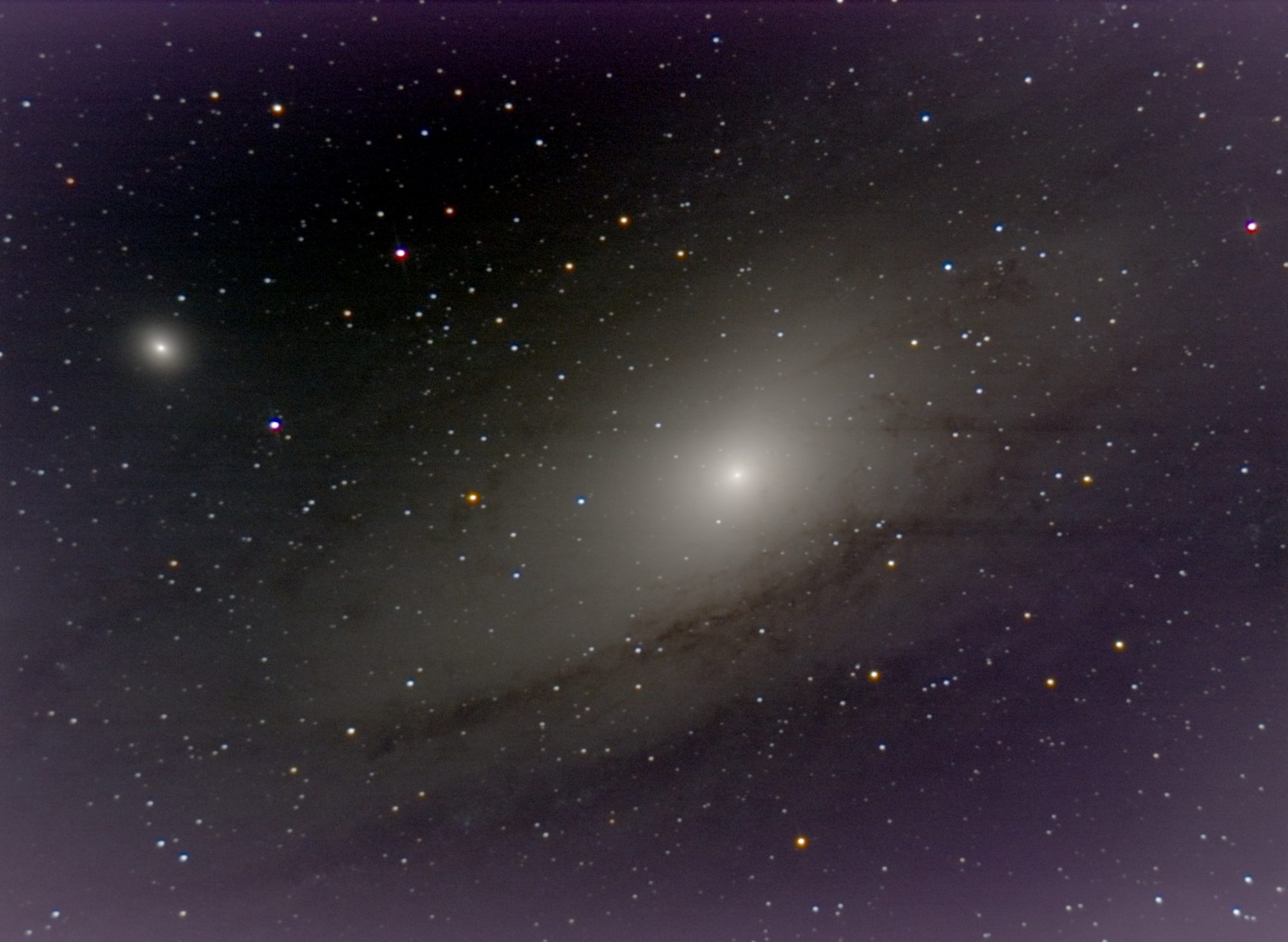
Andromeda
by Ryan Clinton · Night of 3 to 4 November 2026, from 02:41 GMT
Stats for nerds
- Telescope
- Sky-Watcher Explorer 150P Newtonian, 150 mm f/5, 750 mm focal length. No corrector or Barlow.
- Mount
- Sky-Watcher EQ3 Pro with its SynScan handset, driven over USB by TelescopeYoke. Unguided: the target is plate-solved and re-centred automatically.
- Camera
- Altair Hypercam 183C (Sony IMX183, colour, uncooled). Gain 1500 (Altair's scale), 16 s exposures, 1.32"/pixel in the stack.
- Filters
- None.
- Accessories
- An Ubuntu laptop beside the telescope running TelescopeYoke, which plans the night and drives the mount, camera and stacking.
- Exposures
- 112 frames of 16 s, of which the best 46 were kept: 12 minutes 16 seconds in all.
- Calibration
- Not recorded with this stack.
- Sky
- Measured from the stack: sky about 17.6 magnitudes per square arcsecond (unfiltered, roughly Gaia G), stars 6.6" across, 1297 stars detected.
- Capture software
- TelescopeYoke, my own open-source Python software (github.com/Ryan-Clinton/telescopeyoke), with Altair's camera library and INDI.
- Processing software
- TelescopeYoke's own stacking and processing (Python: numpy, scipy, astropy). No PixInsight, Siril or Photoshop.
- Processing
- TelescopeYoke's restack. Every raw frame was measured and the poor ones dropped. The rest were lined up on the sharpest frame, the better frames weighted more, and averaged with outliers (satellites, aircraft, cosmic rays) clipped out. Then the sky gradient was removed and the picture stretched.
- Notes
- The galaxy's core with its dust lanes, and M32 at the left. This stack was also part of my nova patrol of M31: it was checked against a reference image of the galaxy for anything new.