Pleiades (M45)
A family of young stars about 440 light years away, born together about 100 million years ago.
Six or seven stars to the eye; binoculars turn it into dozens.
Source: NASA Hubble, the Pleiades
- Open cluster, in Taurus, magnitude 1.2, 150′ across by 150′.
- Highest at midnight around November; in the evening sky a month or two after that.
- Never rises from south of about 66° S; never sets from north of about 66° N.
- Kind, position and size from OpenNGC (CC BY-SA 4.0); magnitude from OpenNGC.
Is it up tonight? Meanwhile works it out for your sky
Pictures sent in
Through Send me your picture, newest first, each credited to whoever took it. Stats for nerds is what they told us about how they took it.
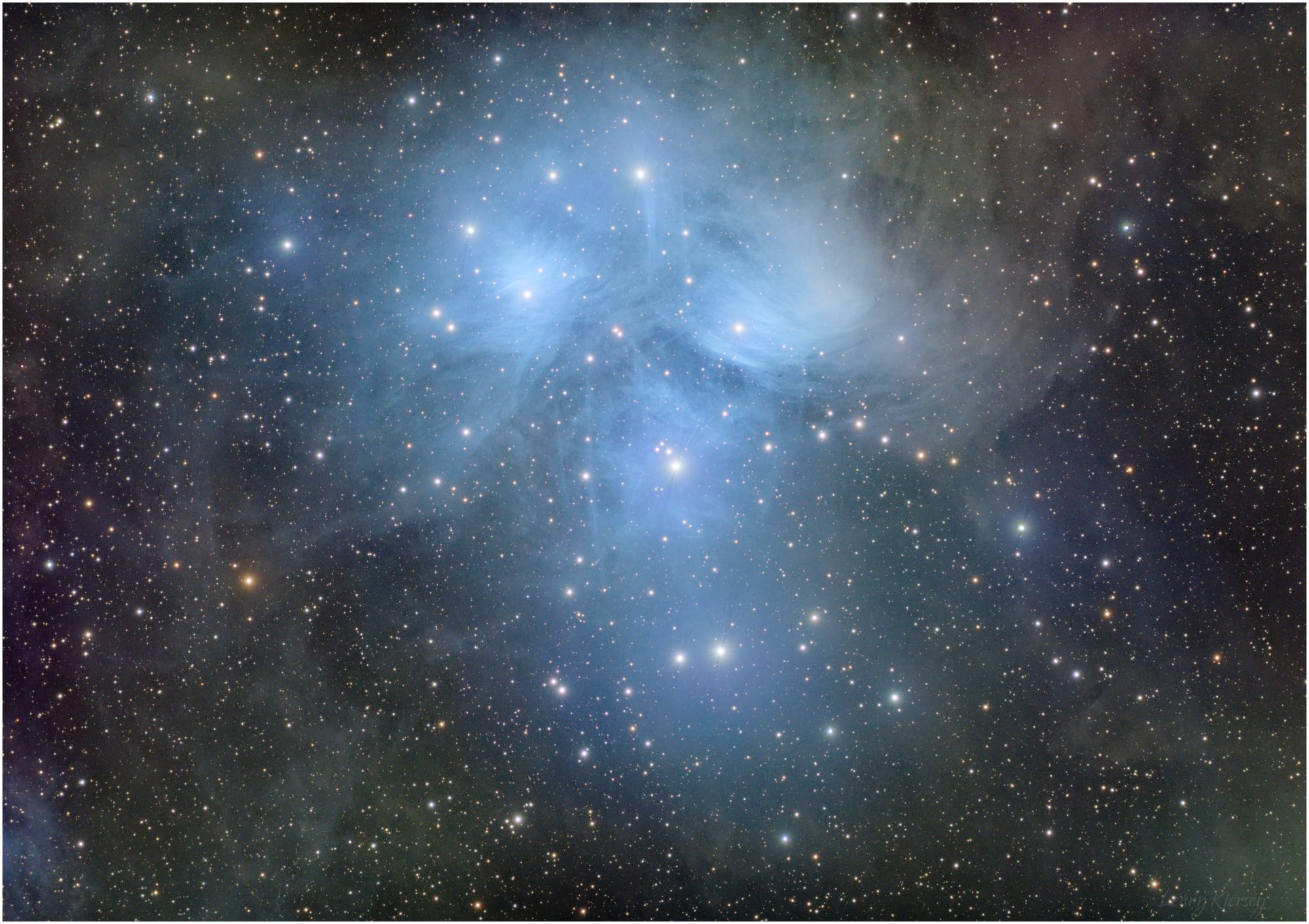
The Seven Sisters
by Lenny Kiersey · 19th October 2026
Stats for nerds
- Telescope
- Skywatcher 72ED 420mm
- Mount
- Mount-Sal33
Guidescope - Altair 50mm with GPCAM130 RMS~1.1 - Camera
- Altair Astro 26C 100 Gain Offset 396 at -5 1x1
- Accessories
- SXFilter Wheel, Altair Astro Focuser and usb dew heater strap
- Exposures
- 140x180s
7 hrs total Integration - Calibration
- Master Dark from 50 frames
- Sky
- Bortle 6-7 reasonable seeing
- Capture software
- Captured with Kstars and Ekos on Pi4 running StellarMate.
- Processing software
- Processed in Pixinsight with Blurx.
- Processing
- Initial crop, SP Flux calibration Multiscale gradient
SPCC, Blur X correct only.
Blur X , MLnoise reduction
Multiscale adaptive stretch
Curves and histogram adjustments.
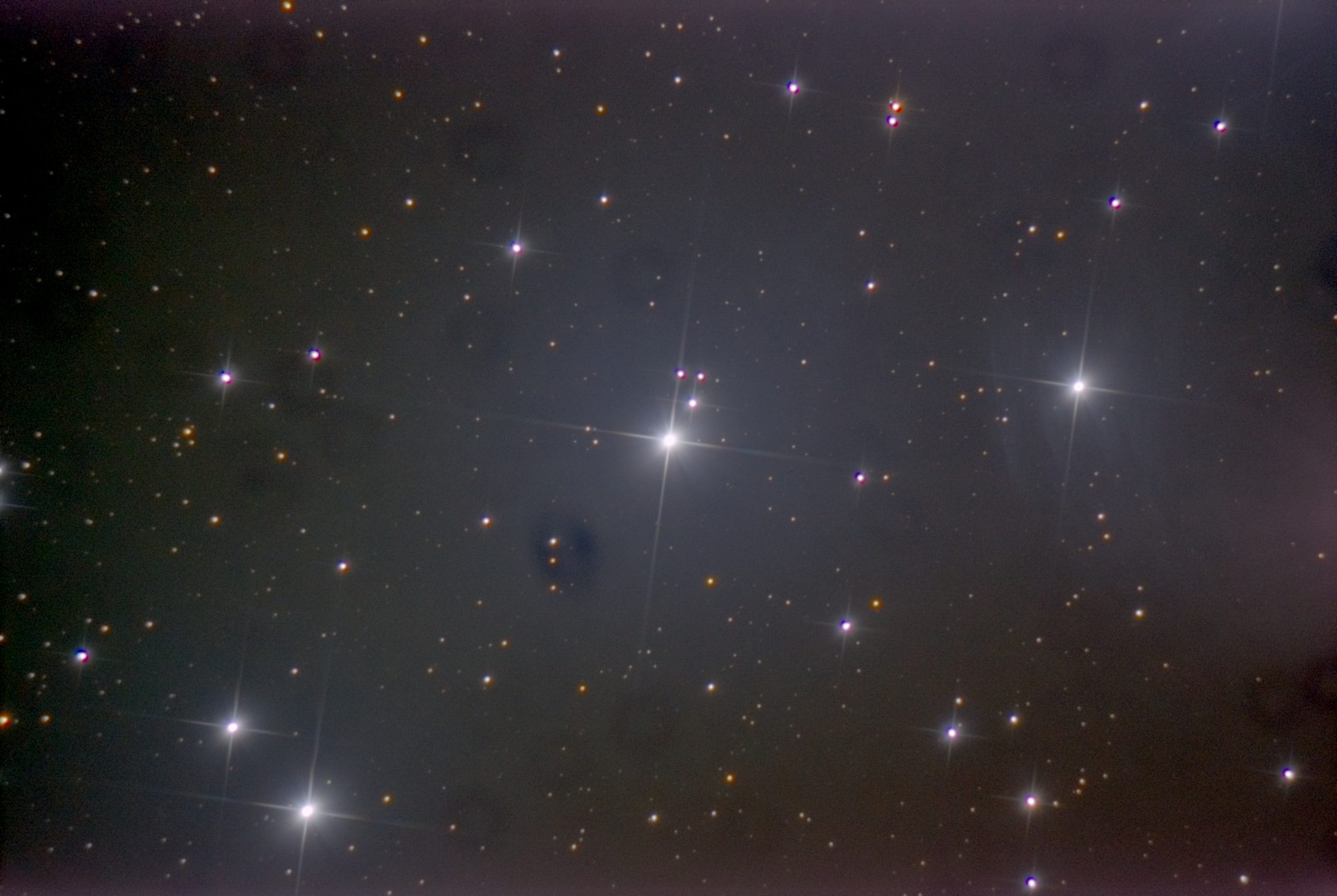
The Pleiades
by Ryan Clinton · Night of 13 to 14 October 2026, from 01:22 UTC
Stats for nerds
- Telescope
- Sky-Watcher Explorer 150P Newtonian, 150 mm f/5, 750 mm focal length. No corrector or Barlow.
- Mount
- Sky-Watcher EQ3 Pro with its SynScan handset, driven over USB by TelescopeYoke. Unguided: the target is plate-solved and re-centred automatically. Polar alignment 0.1° that night.
- Camera
- Altair Hypercam 183C (Sony IMX183, colour, uncooled). Gain 1500 (Altair's scale), 16 s exposures.
- Filters
- None.
- Accessories
- An Ubuntu laptop beside the telescope running TelescopeYoke, which plans the night and drives the mount, camera and stacking.
- Exposures
- 123 frames of 16 s, of which the best 77 were kept: 20 minutes 32 seconds in all.
- Calibration
- Not recorded with this stack.
- Capture software
- TelescopeYoke, my own open-source Python software (github.com/Ryan-Clinton/telescopeyoke), with Altair's camera library and INDI.
- Processing software
- TelescopeYoke's own stacking and processing (Python: numpy, scipy, astropy). No PixInsight, Siril or Photoshop.
- Processing
- TelescopeYoke's restack. Every raw frame was measured and the poor ones dropped. The rest were lined up on the sharpest frame, the better frames weighted more, and averaged with outliers (satellites, aircraft, cosmic rays) clipped out. Then the sky gradient was removed and the picture stretched.
- Notes
- Taken while Andromeda crossed the meridian, the night I found my polar alignment was 3° out rather than the 0.2° I'd believed, and got it to 0.1°. The blue haze is the dust the cluster is passing through. The dark ring below the middle is dust on the camera.