Iris Nebula (NGC 7023)
Dust lit blue by a young star about 1,300 light years away; the first place neutral buckyballs were found in space.
A small telescope from a dark site shows a faint haze around a bright star; a camera shows the blue petals and dark dust around them.
Source: https://en.wikipedia.org/wiki/Iris_Nebula, https://arxiv.org/abs/1009.0539
- Nebula, in Cepheus, B-band magnitude 7.2, 10′ across by 8′.
- Highest at midnight around August; in the evening sky a month or two after that.
- Never rises from south of about 22° S; never sets from north of about 22° N.
- Kind, position and size from OpenNGC (CC BY-SA 4.0); magnitude from OpenNGC.
Is it up tonight? Meanwhile works it out for your sky
Pictures sent in
Through Send me your picture, newest first, each credited to whoever took it. Stats for nerds is what they told us about how they took it.
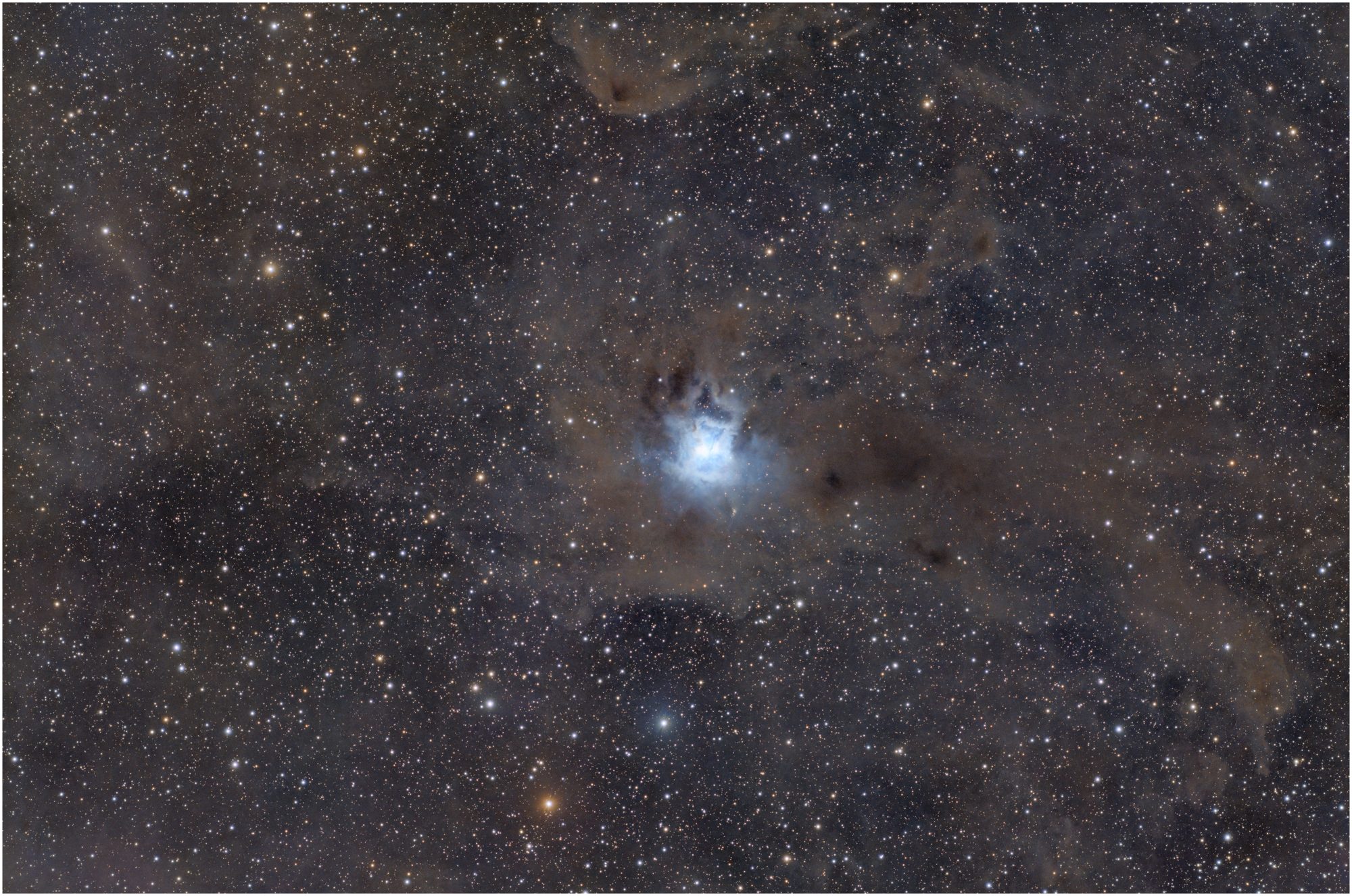
Iris Nebula
by Lenny Kiersey · 25th July 2026
Stats for nerds
- Telescope
- Skywatcher 72ED@420mm
- Mount
- Mount:Sal-33
50mm guide scope with GPCAM130 - Camera
- AA26C@-5C gain 100 offset 396
- Accessories
- Altair focuser and SX filter wheel, raspberry pi4 running StellarMate
- Exposures
- 80x3mins for 4hrs integration
- Calibration
- Master Dark
- Sky
- Bortle 5
- Capture software
- Kstars and Ekos
- Processing software
- Pixinsight
- Processing
- Dynamic crop,SPFC, gradient removal, SPCC, blur X, noise X, stretch to linear, star removal, further histogram and curves tweaks. Add back in stars final curves.