Saturn
9 times Earth's width, with rings of ice reaching 282,000 km from the planet but mostly about 10 metres thick.
A steady yellowish point to the eye; a small telescope at 30 times or more shows the rings, and Titan beside it.
Source: NASA Science, Saturn facts
- A planet: where it is changes through the year, so Meanwhile works out each night whether it's up for you.
Is it up tonight? Meanwhile works it out for your sky
Pictures sent in
Through Send me your picture, newest first, each credited to whoever took it. Stats for nerds is what they told us about how they took it.
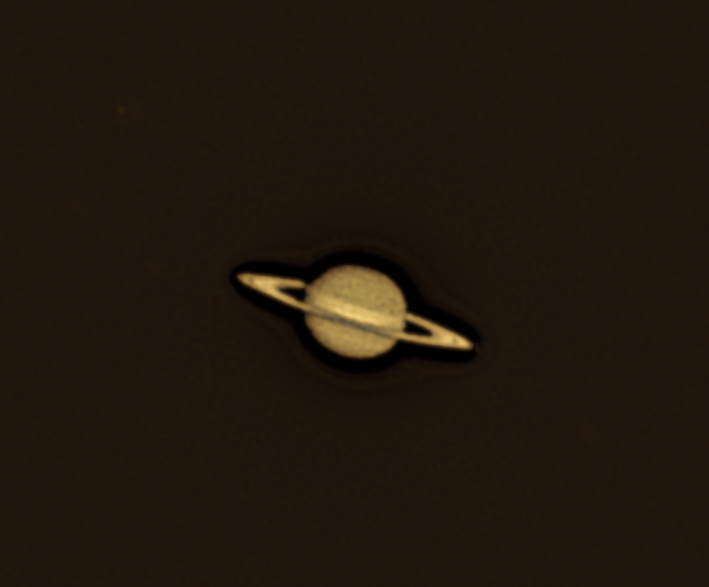
Saturn
by Andrew McGrady · 7th Nov 2026
Stats for nerds
- Telescope
- Omegon RC Pro 154. Richey-Chretian Reflector
Aperture = 152 mm; focal length = 1370mm - Mount
- ZWO AM5. Do not use the guider for planetary
- Camera
- ZWO ASI2600 MC Pro. Cooled. Sensor cooled to -10c
- Filters
- UV/IR
- Accessories
- ASIair Pro
- Exposures
- 5 times 3 minute AVI Videos
- Sky
- Bortle 7
- Capture software
- ASIair Video mode
- Processing software
- Strata (for Mac). GIMP
- Notes
- Have tried to capture Saturn many times. This attempt was to try out Strata planetary processing software on the Mac. Next step is to add an ADC to the image chain.
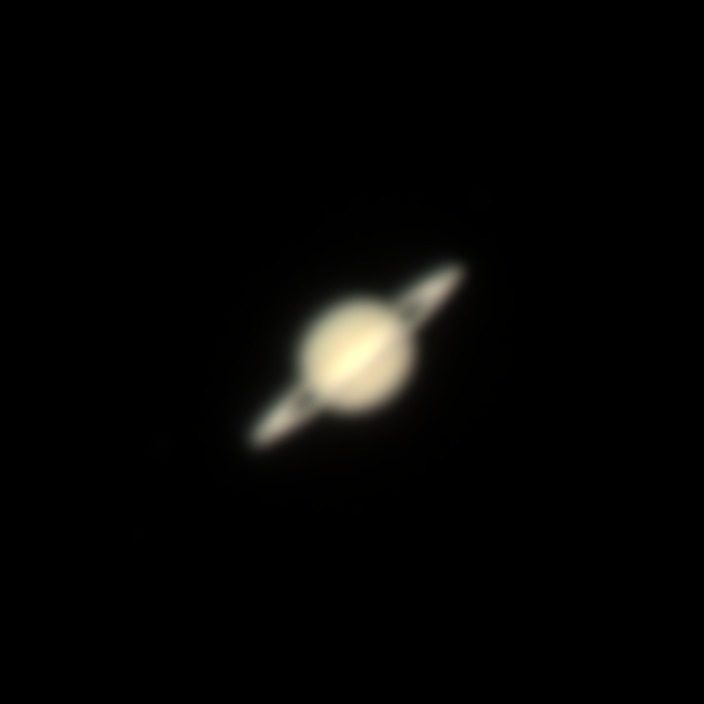
Saturn
by Ryan Clinton · Night of 13 to 14 October 2026
Stats for nerds
- Telescope
- Sky-Watcher Explorer 150P Newtonian, 150 mm f/5, 750 mm focal length. No Barlow, so Saturn is tiny.
- Mount
- Sky-Watcher EQ3 Pro with its SynScan handset, driven over USB by TelescopeYoke. Unguided.
- Camera
- Altair Hypercam 183C (Sony IMX183, colour, uncooled), 20 ms exposures.
- Filters
- None.
- Accessories
- An Ubuntu laptop beside the telescope running TelescopeYoke, which plans the night and drives the mount, camera and stacking.
- Exposures
- 160 frames of 1/50 s (20 ms). The sharpest 40 were stacked.
- Calibration
- None.
- Capture software
- TelescopeYoke, my own open-source Python software (github.com/Ryan-Clinton/telescopeyoke), with Altair's camera library.
- Processing software
- TelescopeYoke's own planet mode (Python: numpy, scipy). No AutoStakkert, RegiStax or Photoshop.
- Processing
- TelescopeYoke's planet mode. A square round the planet was cut from each frame, and the sharpest quarter was lined up on the best frame and stacked. The result was sharpened, and Saturn was given its usual colour on average, because the camera's own colour balance can't be trusted at such short exposures.
- Notes
- My first Saturn, the same night as Andromeda and the Pleiades. The rings and the gap between them and the planet show on both sides. A 2× Barlow and faster capture are next.